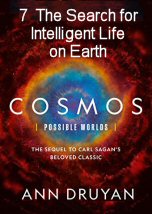
Episode 7 focuses specifically on first contact and the search for intelligent life in the vastness of the cosmos. Are humans ready to make first contact with other intelligent beings? Is our technology even sophisticated enough to detect communication signals from another world? Who are we to search for alien intelligence when we can't even recognize or respect the consciousness all around us, or even beneath our feet. Neil deGrasse Tyson reveals the hidden underground network that is a collaboration of four kingdoms of life, and a true first contact story between humans and beings who communicate in a symbolic language and have maintained a representative democracy for many tens of millions of years.
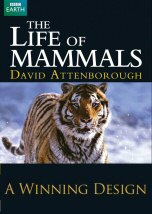
Whales have long been a profound mystery to us. They live in a world so removed from our own that we can barely imagine their lives. Their environment is different, their senses are different, their relationships are different. How might such almost alien creatures see the world?, Narrated by David Attenborough.
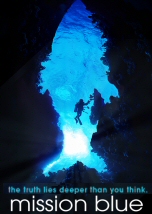
The deep is perhaps the most hostile environment on earth, at least to us - a world of crushing pressure, brutal cold and utter darkness. We have barely begun to explore it, and yet it is the largest living space on the planet. Scientists already think that there is more life in the deep than anywhere else on earth. This episode takes us on an epic journey into the unknown, a realm that feels almost like science fiction. We discover alien worlds, bizarre creatures and extraordinary new behaviours never seen before. We encounter savage hordes of Humboldt squid hunting lanternfish in the depths and coral gardens flourishing in absolute darkness, with more species of coral to be found in the deep than on shallow tropical reefs. Narrated by David Attenborough.
The search for extraterrestrial life is an age-old quest. But recent breakthroughs make today an era like no other in the history of astronomy. From the exhilarating probing of our own solar system and the Kepler mission’s astounding discovery of thousands of extrasolar planets, to the next-generation telescopes under development, the prospects for finding life beyond Earth have never been stronger. Still, daunting hurdles remain. How can we study anything light years away, let alone a little planet? In the vast universe, where should we even start to look? Is our failure to hear any other voices in the galaxy a sign that we are special? Join leading explorers now searching the galaxy for life and intelligence on other planets—and asks, if we do find other life in the universe... what would that mean?
We are the generation of human beings that are going to know whether or not we're alone in the universe. This episode explores the search of exoplanets, from ancient Greek philosophers to the discoveries made possible with the Kepler Telescope. Unbelievable new worlds, planets made of diamond, planets of raining glass, worlds in collision, some plunging into stars, and others that just might harbor life. Thanks to today's planet hunters, our views of the universe and of our place in it are undergoing one of the greatest revolutions in scientific history.
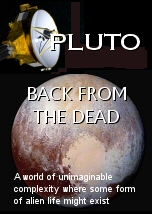
The incredible story of how Pluto has been propelled from an unremarkable ball of ice on the edge of the solar system to a world of unimaginable complexity - where some form of alien life might exist. New discoveries from the edge of the solar system are transforming what is known about Pluto, thanks to the New Horizons space probe that took the first-ever close up images of the planet. Pluto was once thought to be geologically dead, but the pictures revealed it to be an active world of stunning complexity, with mountains carved from ice, a nitrogen glacier that appeared to be moving and a recently active volcano, with data sent back lead some scientists to speculate that there may even be life on Pluto today.











Neil deGrasse Tyson reveals the hidden underground network that is a collaboration of four kingdoms of life, and a true first contact story between humans and beings who communicate in a symbolic language and have maintained a representative democracy for many tens of millions of years.