






Last Watched

"Insects"  Sort by

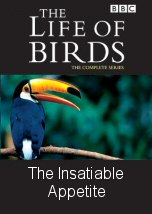
The Insatiable Appetite

   1998    Nature
The next instalment focuses on dietary needs and how different species have evolved beaks to suit their individual requirements. The latter come in a multitude of forms. Blue tits and goldfinches have beaks akin to tweezers, with which to extract seeds, while the hawfinch's razor-like bill can deal with a cherry-stone. However, the crossbill is the only finch that can twist its mandibles in opposite directions. Jays store acorns for winter by burying them in the ground, whereas woodpeckers can keep up to 60,000 of them in one tree trunk. Sap is also desirable, and there are a variety of methods used to obtain it. The hoatzin is the only specialised leaf-eater, and accordingly has a digestive system more akin to that of cattle. Plants recruit birds to aid pollination, and offer nectar as a reward. Hummingbirds eat little else, and the sword-bill's beak is the longest of any bird in relation to its body. Insects are also highly prized, and Galapagos finches are shown to possess some ingenuity as they not only strip bark, but also use 'tools' to reach their prey. Crows are hailed as being among the most intelligent birds, and one is shown using a twig to spear a grub within a fallen log. The robin is an opportunist, and Sir Attenborough observes one seizing morsels as he digs a patch of earth. In South America, a cattle tyrant sits atop an obliging capybara and uses its vantage point to spot passing food that may be dislodged by its grazing partner.
Series: The Life of Birds
Planet Earth II Grasslands

   2016    Nature    HD
Grasslands cover one quarter of all land and support the vast gatherings of wildlife, but to survive here animals must endure the most hostile seasonal changes on the planet. From Asia's bizarre-looking Saiga antelope to the giant anteaters of Brazil, grassland animals have adapted in extraordinary ways to cope with these extremes. In the flooded Okavango, lions take on formidable buffalo in epic battles, on the savannah bee-eaters take advantage of elephants to help catch insects and, on the freezing northern tundra, caribou embark on great migrations shadowed by hungry Arctic wolves.
Series: Planet Earth II

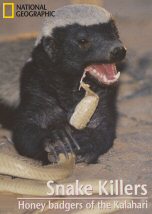
Snake Killers Honey Badgers of The Kalahari

   2007    Nature
The honey badger looks like something you might buy in pet shop and give to children, but turns out to be one of the most violent and determined creatures ever to scuttle across the face of the earth. Nothing in the badger’s world-not even the badgers themselves-are safe from its remarkable ability to create havoc and cause harm. Like a meter long skunk with the brain of a shark the Honey Badger’s metabolism compels it to eat constantly and live on the run. Its diet is admirably inclusive ranging from insects to its own young. If an animal is too big to eat then the badger will fight it anyway, indeed it is this almost supernatural tenacity that compels you respect it, as well as yielding some of the most spectacular sequences in the film. Five foot long cobra sleeping in the top of tree? No problem, the badger scoots up and bites its head off. When an ailing badger is attacked by a full size leopard it takes the leopard over an hour to finish it off. When one is bitten in the face by a snake that can kill a man, it just lies down for a while and sleeps it off.

Wilding

   2021    Nature
Jeremy Clarkson decides to become a naturalist. 'In just 30 years, insect numbers have dropped by 25% and they're still falling. Without insects, all life on Earth ends. Everywhere where insects like to live is disappearing and I've decided to do something about that. My plan is to make my hedgerows, my valleys, my woods, and my streams more attractive to creepy crawlies. In essence, I am going to leave chunks of the farm completely alone. I'm going to put Mother Nature in the driving seat. It's a process called wilding.'
Series: Clarkson Farm

Ants: Secret Power of the Nature

   2011    Nature
In this documentary we will be transported into the world of ants. What animal has achieved immortality? What animal is the most warlike? What animal has the greatest supercity on the planet? Not man but ants. They are the real success story. It is only their tiny size and our vanity that allows us to hold onto the myth of our supremacy. Ants rule the planet. They are found in more habitats from far northern Finland to the sweltering tropics. The largest colony known of these insects is in Japan, where 306 million ants, with 1 million queens, in 45,000 colonies spread over 270 hectares. The fiercest warriors on earth are the slave maker ants. Other ants have barracks and sentry posts to protect themselves against surprise attack.

Is a Zombie Apocalypse Possible

   2014    Medicine
It is a nightmare that has stalked us for centuries: hordes of human beings transformed into mindless, cannibalistic monsters. Could this civilization-ending nightmare become reality? Scientists have discovered pathogens that turn insects into the walking dead. New strains of viruses are attacking humans every day. Mathematicians have calculated the likelihood of surviving a zombie virus outbreak: they’re not hopeful. Now neuroscientists are discovering how easy it is for us to lose conscious control of our bodies. Are we at risk of becoming puppets? If we were in the middle of a zombie apocalypse, would we even know it?
Series: Through the Wormhole Season 5
Breakthrough

Breakthrough

2019  Medicine
Human Planet

Human Planet

2011  Culture
Zeitgeist

Zeitgeist

2007  Culture
Clarkson Farm Season 2

Clarkson Farm Season 2

2023  Nature
The Hunt

The Hunt

2015  Nature
Planet Earth

Planet Earth

2007  Nature