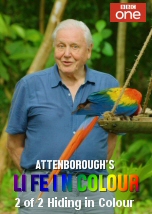
David Attenborough reveals the extraordinary ways that some animals use colour to hide and disappear into the background. New science reveals how the Bengal tiger in central India uses its orange-black stripes to hide from its colour-blind prey. In Kenya’s Masai Mara, the zebra’s black-and-white pattern confuses predators with an extraordinary effect called motion dazzle. And on the island of Cuba, a small snail uses colourful stripes in a surprising way to hide from its enemies. Other animals use colour to trick and to deceive. On Australia’s Great Barrier Reef, a blue-striped blenny uses colours to mimic other fish and launch a sudden attack. In the grasslands of Zambia, the chick of a pin-tailed whydah mimics the patterns of its nest mates to ensure that it is not detected as an imposter. And specialist cameras reveal how a tiny crab spider uses bright ultraviolet colours to lure in its victims.
In the last episode of the series, Freeman examines different faiths' views on miracles, meeting a man who survived falling 47 storeys and a cancer patient who believes his illness can be cured by prayer.
Travel from the inner solar system to the Kuiper Belt and explore the moons surrounding the planets of the solar system. Many of these moons that were once unknown are now on the cutting edge of astronomical study. Some burst with volcanic fury another spews icy geysers and others offer the possibility of alien life. Are these strange worlds simply hostile environments unfit for humans or do other possibilities exist? Cutting-edge computer graphics are used to bring the universe down to earth and to imagine what kind of life forms might evolve in alien atmospheres.
In the 1960s and 1970s a generation of Mexican Americans, frustrated by persistent discrimination and poverty, find a new way forward, through social action and the building of a new "Chicano" identity. The movement is ignited when farm workers in the fields of California, led by Cesar Chavez and Dolores Huerta, march on Sacramento for equal pay and humane working conditions. Through plays, poetry and film, Luis Valdez and activist Corky Gonzalez create a new appreciation of the long history of Mexicans in the South West and the Mestizo roots of Mexican Americans. In Los Angeles, Sal Castro, a schoolteacher, leads the largest high school student walkout in American history, demanding that Chicano students be given the same educational opportunities as Anglos. In Texas, activists such as Jose Angel Gutierrez, create a new political party and change the rules of the electoral game. By the end of the 1970s Chicanos activism and identity have transformed what it means to be an American. Chicano and Latino studies are incorporated into school curriculum; Latinos are included in the political process.
David Attenborough comes face-to-face with a baby rhino and asks what the future holds for this little one. He meets the local people who are standing side-by-side with the wildlife at this pivotal moment in their history. We discover what it takes to save a species, hold back a desert and even resurrect an entire wilderness - revealing what the world was like before modern man.
Step into a time when the boundary between life and death was guided by magic, faith, and the written word. This documentary unearths an extraordinary artifact dating back to about 1880 BCE—a scroll known as potentially the oldest document in human history, lost for centuries and rediscovered in 1887. Through expert interviews, archeological evidence, and stunning visuals, viewers are taken on a journey across ancient Egypt: exploring how this manuscript shaped funerary beliefs, mortuary rituals, and the very concept of the afterlife. Witness the power of this papyrus as it reveals secrets of gods and judgment, spells to navigate dangerous gates, and the yearning for immortality. For anyone fascinated by history, spirituality, or mysteries from the distant past, this film brings alive a document that influenced civilization itself.























Other animals use colour to trick and to deceive. On Australia’s Great Barrier Reef, a blue-striped blenny uses colours to mimic other fish and launch a sudden attack. In the grasslands of Zambia, the chick of a pin-tailed whydah mimics the patterns of its nest mates to ensure that it is not detected as an imposter. And specialist cameras reveal how a tiny crab spider uses bright ultraviolet colours to lure in its victims.