The price of Caesar's mercy: Cicero nominates Caesar to an unprecedented ten-year dictatorship and Brutus speaks in support of the motion. With martial authority and Niobe at his side, Vorenus campaigns for magistrate under Posca's advice, but is shocked to learn from Posca that Caesar has already fixed the election in Vorenus's favor. Meanwhile, Atia continues her humiliation of Servilia while denying any involvement in her assault.
Eisenhower and the CIA played a great part in the shaping of the world in the 1950's; the development of the Cold war and the nerve-wrecking battle against communism, driven on by the U.S.
During 1964-1969 both sides now plan to put a man on the Moon - while the Soviets struggle, the Americans pull ahead in the space race with Project Gemini, but then suffer a disaster with the Apollo 1 fire. The Soviet space programme suffers its own blows: Sergei Korolev dies when his heart fails during an operation, Soyuz 1 crashes and kills cosmonaut Vladimir Komarov, and their planned moon rocket, the N-1 rocket, fails to successfully launch. In America, von Braun has difficulties with the Saturn V, but they are overcome, and the rocket successfully launches the first manned lunar mission, Apollo 8, and the first manned lunar landing, Apollo 11.
We think of comets as beautiful glowing balls of light streaking across our skies with their long sweeping tails, yet comets are so much more than just a cosmic firework display. Comets have a uniquely important place in modern science. As time machines from the early universe, they could hold the key to unlock the secrets of the cosmos. Comets could even be the origin of life itself. We follow the incredible odyssey of a comet as it sails through the solar system, watching it's every move as it evolves from a dormant chunk of ice and rock into a tumbling, violently active nucleus engulfed in a gaseous haze. What we learn is a revelation; comets are even more mysterious and fascinating than we had ever imagined.
This episode examines the idea of scientific racism, an ideology invented during the 19th century that drew on now discredited practices such as phrenology and provided an ideological justification for racism and slavery. The episode shows how these theories ultimately led to eugenics and Nazi racial policies of the master race.
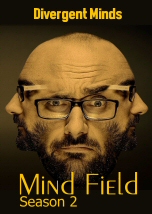
Autistic minds provide windows into how we all think, feel, and behave. A complete brain science should be able to account for all kinds of minds and brains. As long as some minds remain a mystery, so too will all minds. Michael Stevens travels to London to meet a blind, autistic savant with astonishing musical abilities, and volunteers to have his brain's function temporarily disrupted at UCLA's Neuromodulation Lab.














Meanwhile, Atia continues her humiliation of Servilia while denying any involvement in her assault.