








Last Watched

"Lion"  Sort by

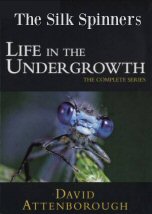
The Silk Spinners

   2005    Nature
Silk is the invertebrates' great invention, used in a range of ways from from the protective stalks of lacewing eggs to the amazing hanging threads of New Zealand's 'glow worms'. Spiders, though, have taken silk-spinning to extremes. The common wolf spider has no web, but the female is a gentle parent, encasing her eggs in silk and carrying the precious bundle wherever she goes. The bolas spider uses a ball of sticky silk soaked in a copy of moth pheromone to lure its prey. Millions of communal spiders live and feed together in a vast, towering web - an arachnophobe's nightmare.
Series: Life in the Undergrowth
Terraform

   2018    Science
We sure lucked out with Planet Earth. Blue skies, rolling hills, water everywhere. But our home didn't come like this out of the box. Earth was a real fixer-upper, and it took some seriously hard work to build this paradise. Nearly four billion years of renovation. Some tiny, some huge, to make this house a home. Creatures on Earth don't just live and die. They actually change the world around them.
The story of how for nearly 4 billion years, microbes, plants and animals have emerged and sculpted the planet's surface and atmosphere in the strangest of ways.
Series: One Strange Rock

Lost Kingdoms of South America: People of the Clouds

   2013    History
Dr Jago Cooper reveals the history of some of South America's ancient civilisations. He begins with an epic journey into the remote Peruvian Andes in search of the mysterious Chachapoya people. Once numbering half a million, they were known as the 'People of the Clouds'. Dr Cooper reveals how they developed sophisticated methods of recording stories, traded in exotic goods found hundreds of miles from their territory, and had funeral traditions that challenge assumptions about ancient human behaviour. His search for evidence takes him to astonishing cliff tombs untouched for 500 years and one of the most spectacular fortresses in South America, where the fate of the Chachapoya is revealed.
Series: Lost Kingdoms of South America

Deliver Us from Drought

   2014    Nature
'Deliver Us from Drought' - Over the past years, Texas has experienced the worst drought in its recorded history. 97% of the scientific community agrees that human activity has contributed to extreme weather patterns around the world. But many Texans--legislators, community leaders and citizens--don't attribute their drought to humans, and have taken few if any initiatives to limit the state's CO2 emissions, currently the highest in the country. "The Resource Curse" - As humanity's appetite for energy grows exponentially, the extraction industry scrambles to the most remote regions on Earth. In the undeveloped Melanesian country of Papua New Guinea, America's Exxon Mobil has staked its claim to a $19 billion liquid natural-gas project. While some see Exxon's mammoth presence as the catalyst that will usher the underdeveloped country into the 21st Century, others predict the initiative could plunge its people into civil war.
Series: Vice

Contact

   2018    Technology    HD
Minerva B is a small rocky planet just like earth, where spacecraft Artemis has found water, organic molecules, and complex creatures. Is there something more to find?
'I am the mind of the spaceship, alone among the stars. 50 years ago, from a planet far away, the planet you call home, I launched. A journey of 28 trillion miles across the yawning time of space to the exoplanet, Minerva B: a small, rocky planet, much like Earth, but orbiting another sun. Here, I have found water, organic molecules, and microorganisms. When the news of my discovery reaches Earth years from now, some of you will be amazed. But others will remain unsatisfied, and you will ask, have I not found animals or birds? Have I not met intelligent life like us? And so, my search continues. I will find life of marvellous complexity, and the traces of a devastating loss.'
Series: Living Universe

Gaia The Billion Pixel Camera

   2015    Technology
The Milky Way, our galaxy, is a magnificent sight in the night sky, but we know surprisingly little about it for certain. What is its shape? How many stars does it actually contain? What lies at its centre? The Gaia space telescope will answer these questions, being armed with the most advanced camera to leave our planet, and it will allow us to see our galaxy as we've never seen it before. The Sky at Night visits the factory in Chelmsford that made the astonishing sensor at the heart of the mission.
Series: The Sky at Night