Sir David Attenborough reveals how Mammals have conquered the Earth, uncovering the secrets to their success with their winning design, incredible adaptability, unrivalled intelligence, and unique sociability. 66 million years ago, when the reign of the dinosaurs came to an end, mammals were set free to exploit every corner of the planet. Mammals reveals the strategies, behaviours and traits that lie behind the astonishing success of this remarkable group of animals. Above all, the series celebrates the amazing intelligence that enables mammals to learn, remember, problem-solve, parent, and co-operate. Experience the complete six-episode series in a single video, showcasing how mammals have adapted to thrive in every major environment on Earth. They inhabit every ocean and continent, from frozen wildernesses and dense jungles to baking deserts, the dark depths of the ocean, and even the skies above our forests.
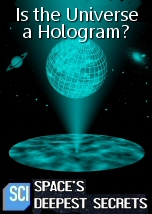
Shocking new evidence has convinced some of the world's greatest physicists that the universe is a hologram. Using cutting-edge technology, they investigate the secrets of black holes and space-time to build the case for this game-changing discovery. The holographic principle is a supposed property of quantum gravity that states that the description of a volume of space can be thought of as encoded on a lower-dimensional boundary to the region like a gravitational horizon. First proposed by Gerard 't Hooft, it was given a precise string-theory interpretation by Leonard Susskind. The holographic principle was inspired by black hole thermodynamics, which conjectures that the maximal entropy in any region scales with the radius squared, and not cubed as might be expected. In the case of a black hole, the insight was that the informational content of all the objects that have fallen into the hole might be entirely contained in surface fluctuations of the event horizon.
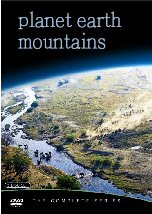
The great mountain ranges are some of the planet's most spectacular landscapes, but they are unforgiving places to live in, and only a few animals have what it takes to live at extreme altitude. Mountain animals are amongst the most elusive in the world, and this film provides unique and intimate glimpses into their secretive lives. Witness the moment four snow leopards come together when a mother and cub become trapped between two rival males. Join grizzly bears as they dance against trees to rub off their winter fur and soar with golden eagles hunting amongst Europe's snow-capped peaks.
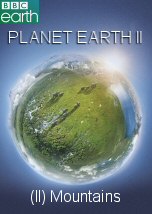
Welcome to an extreme landscape of rock, ice and snow. We tour the mightiest mountain ranges, starting with the birth of a mountain at one of the lowest places on Earth and ending at the summit of Everest. Find out how some of the most secretive animals rise to the challenge of mountain life. Share one of Earth's rarest phenomena, a lava lake that has been erupting for over 100 years. The same forces built the Simian Mountains where we find troops of gelada baboons nearly a thousand strong. In the Rockies, grizzlies build winter dens inside avalanche-prone slopes and climb the peaks to devour abundant summer moths. In another world first, the programme brings us astounding images of a snow leopard hunting on the Pakistan peaks.
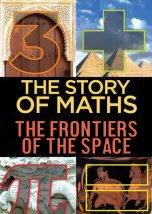
In the third episode we will see Europe by the 17th century taking over from the Middle East as the powerhouse of mathematical ideas. Great strides had been made in understanding the geometry of objects fixed in time and space. The race was on to discover the mathematics to describe objects in motion. This programme explores the work of Rene Descartes, Pierre Fermat, Isaac Newton, Leonard Euler and Carl Friedrich Gauss. Du Sautoy proceeds to describes René Descartes realisation that it was possible to describe curved lines as equations and thus link algebra and geometry. He talks with Henk J. M. Bos about Descartes. He shows how one of Pierre de Fermat’s theorems is now the basis for the codes that protect credit card transactions on the internet. He describes Isaac Newton’s development of math and physics crucial to understanding the behaviour of moving objects in engineering. He covers the Leibniz and Newton calculus controversy and the Bernoulli family. He further covers Leonhard Euler, the father of topology, and Gauss' invention of a new way of handling equations, modular arithmetic. The further contribution of Gauss to our understanding of how prime numbers are distributed is covered thus providing the platform for Bernhard Riemann's theories on prime numbers. In addition Riemann worked on the properties of objects, which he saw as manifolds that could exist in multi-dimensional space.
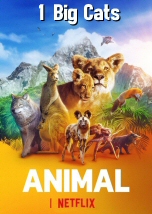
This immersive series follows the world's most magnificent creatures, capturing never before seen moments from the heartwarming to the outrageous. In the first episode, majestic, powerful and deadly, big cats were once thought to be solitary creatures. But we're now realizing just how collaborative they can be.











66 million years ago, when the reign of the dinosaurs came to an end, mammals were set free to exploit every corner of the planet. Mammals reveals the strategies, behaviours and traits that lie behind the astonishing success of this remarkable group of animals. Above all, the series celebrates the amazing intelligence that enables mammals to learn, remember, problem-solve, parent, and co-operate.
Experience the complete six-episode series in a single video, showcasing how mammals have adapted to thrive in every major environment on Earth. They inhabit every ocean and continent, from frozen wildernesses and dense jungles to baking deserts, the dark depths of the ocean, and even the skies above our forests.