Of all the objects in the cosmos, planets, stars, galaxies, none are as strange, mysterious, or powerful as black holes. Black holes are the most mind-blowing things in the universe. They can swallow a star completely intact. Black holes have these powerful jets that just spew matter out. First discovered on paper, on the back of an envelope, some squiggles of the pen. The bizarre solution to a seemingly unsolvable equation, a mathematical enigma. Einstein himself could not accept black holes as real. People didn't even believe for many years that they existed. Nature doesn't work that way. Yet slowly, as scientists investigate black holes by observing the effect they have on their surroundings, evidence begins to mount.
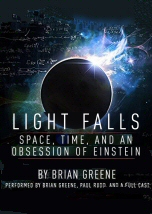
Brian Greene and an ensemble cast perform this theatrucak work tracing Albert Einstein's electrifying journey towards one of the most veautiful ideas ever conceived - the General Theory of Relativity. With state of the art animation and innovative projection techniques, Light Falls illuminates Einstein'sbreakthuroug moments, near misses, agonizing frustrations, and final emergence into the light, as one intrepid mind took on the universe... and won. Best-selling author, superstar physicist, and cofounder of the World Science Festival Brian Greene (The Elegant Universe, The Fabric of the Cosmos) and award-winning actor Paul Rudd (Ant-Man) perform this dramatic story. Featuring an original score by composer Jeff Beal, Einstein’s electrifying journey toward his greatest achievement is brought vividly to life.
Inside the heart of the atom, its nucleus houses energy. This hidden treasure was forged billions of years ago in distant stellar furnaces. The secret of starlight is nothing to fool with. It can bring a civilization to life and it can burn it to the ground. Two atoms from different parts of the universe meet on a small planet. A deadly embrace between science and state altered the fate of the world and a gripping cautionary tale of others who grew used to living in the shadow of grave danger until it killed them all except one.
Author and nuclear physicist Professor Jim Al-Khalili looks at what led to the discovery that everything is made of atoms. The programme looks at how the discovery affected the scientific world including the atomic energy theories of Albert Einstein and Werner Heisenberg and quantum mechanics
Since the dawn of civilization, humans have wondered who or what created the universe. Religion offers a spiritual answer, but do the latest discoveries in physics show evidence of a transcendent intelligence, or simply that the laws of physics by themselves could have led to the universe in which we live? This episode embarks on a mind-bending scientific search for God, asking physicists and theologians if the seemingly miraculous way the universe has been calibrated to support life is evidence of a creator...whether string theory will eventually be able to rule out the existence of God...why Stephen Hawking says the universe could have been created spontaneously...and how an advanced civilization in another universe could have conceivably created our own.
We as humans often question the creation of the universe. How was the universe created? How does it work? This series uses global experts from organizations like NASA and CERN to help us understand how this works, and uses CGI to demonstrate the phenomena. Episode 1 starts the new season as we dive deep into the black holes. The galaxy M87 is known for having at the core a super massive black hole. This black hole is the first ever photographed and we will witness the experts trying to find out the secrets of this famous black hole. In the meantime, they have overcome the scorching winds and death ray jets. And of all its hurdles, the event horizon will be the most difficult. This place is known for its uniqueness of time and space, where time stays still while the laws of physics fail.
















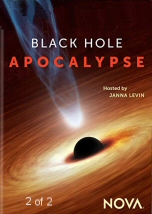






First discovered on paper, on the back of an envelope, some squiggles of the pen. The bizarre solution to a seemingly unsolvable equation, a mathematical enigma. Einstein himself could not accept black holes as real. People didn't even believe for many years that they existed. Nature doesn't work that way. Yet slowly, as scientists investigate black holes by observing the effect they have on their surroundings, evidence begins to mount.