












Last Watched

"Predator"  Sort by

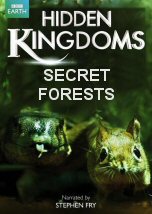
Secret Forests

   2014    Nature
This is the story of two tiny animals coming of age. In the wild woods of North America, a young chipmunk is gathering a vital store of nuts ahead of his first winter - in his way are ruthless rivals and giant predators. In the steaming rainforest, a young tree-shrew is forced deep into the jungle to find food. She must draw on all her intelligence and agility if she is to escape the ultimate jungle predator - a reticulated python!
Series: Hidden Kingdoms
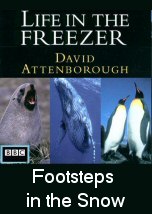
Footsteps in the Snow

   1993    History
This episode discusses the human exploration of Antarctica, in particular the mission led by Captain Robert Falcon Scott, whose team died on the way back from the South Pole. It shows the scientific work in the modern human bases in Antarctica, especially Mawson Base and its observation of Adelie Penguins (partially through tracking devices). The second half of the episode describes how the series was made. Most crucial was of course the camera work. To get access to the wildlife of the sea, for example, boats, divers, suspended capsules and remotely controlled cameras mounted on inflatables were used. Particularly dangerous to divers were Leopard Seals and other predators. The film concludes that although working in Antarctica is now much easier than during the early days of exploration, human footsteps on the continent are still exceedingly rare in part because of international treaties prohibiting industrial exploitation.
Series: Life in the Freezer

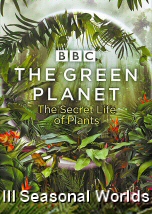
Seasonal Worlds

   2022    Nature
Will explore the strategy, deception and feats of engineering plants use to thrive in the changing weather of different seasons. In the face of conditions ranging from ice and snow to raging fires, survival is often a question of perfect timing - particularly when contending with intense competition and surprising predators.
In this episode, David Attenborough travels to Finland to show one of the most extreme examples of seasonal plant life in the Arctic Circle. He also travels to California to see how climate change is affecting giant sequoias. These ancient trees like all other seasonal plants depend on the predictability of the seasons and our current changing climate threatens their survival.
Series: The Green Planet

Eden

   2020    Science
Planets beyond our solar system are known to astronomers as exoplanets. They are at trillions of miles from Earth and yet, it might be possible to detect a faint signature of life in them. From the light of the stars they orbit that passes through the atmosphere of an exoplanet, it is possible to capture the chemical fingerprint of the elements in that atmosphere.
The fictional world Eden is orbiting not one star, but two. The light from its twin stars powers photosynthesis, pumping more oxygen into the atmosphere than in Earth, allowing life to thrive. Grazers are constantly alert to danger, because the canopy is home to predators perfectly evolved to live among the trees. In Episode 3, another topic are fungi and the role they could play on exoplanets. Ecologist Thomas Crowther talks about the role mycelial networks play in the Rothiemurchus forest in Scotland.
Series: Alien Worlds

Desert Worlds

   2022    Nature
Plants that have developed to thrive in the desert, including cacti that grow in the shade of other trees and collect water in pleated trunks that expand and contract - but can also find themselves a host to other plants, like desert mistletoe. This programme also reveals how tobacco plants being eaten by caterpillars are able to summon the creatures' natural predators, and how tumbleweeds roll across the landscape, only unfurling and growing when they encounter rain.
Series: The Green Planet

Planet Earth III: Ocean

   2023    Nature
This second episode is a captivating exploration of the ocean's wonders and mysteries. It reveals how a significant part of our planet remains unexplored, primarily due to its vast water coverage. The film emphasizes the extraordinary discoveries awaiting every journey below the water's surface, with over a thousand new species identified annually. Home to 80% of all animal life on Earth, the ocean's diverse habitats host a range of surprising behaviors and life-and-death struggles, often hidden beneath a serene exterior.
The shallow tropical seas, appearing as paradises, are actually arenas of intense survival battles. Predatory lionfish, with their patient hunting tactics, and clown frogfish, using a unique fishing rod-like dorsal fin as a lure, demonstrate the ocean's complex food web. The documentary also explores the kelp forests off the North American coast, revealing their role as nurseries for young horn sharks. Amidst these underwater forests lurk giant sea bass, wolf-eels, and various sharks like houndsharks and broadnose sevengills, posing significant threats to the smaller inhabitants. The episode takes viewers to the twilight and midnight zones of the ocean, unveiling alien-like creatures such as the siphonophore, glass squid, and gulper eel, adapted to the extreme conditions of deep waters. The journey concludes with the moving story of the pearl octopus, whose devotion to her eggs in the challenging deep-sea environment is both heartwarming and heartbreaking.
This episode is not only a showcase of the ocean's diverse inhabitants but also a reminder of the urgent need to understand and protect this vast, mysterious, and vital part of our planet.
Series: Planet Earth III