












Last Watched

"NES"  Sort by

Blood Filled Streets

   2016    History
After the murder of his brother Frank, Al Capone is out for revenge against William Dever and the Chicago police. He plots to kill every undercover cop that was in Cicero on the day of Frank’s death. Before he can set his plan in motion, however, Johnny Torrio returns from Italy and reclaims his control of their criminal empire. Torrio forbids Capone from killing cops, fearing it would spark an all-out war. Despite Capone’s personal loss, Torrio returns to a booming business that’s raking in $10 million a month. However, as Torrio and Capone’s empire grows, it becomes harder to keep smaller factions under control. After a small group of Italian mobsters attacks one of Dean O’Banion’s distilleries, O’Banion blames Torrio and decides to end their business partnership. He announces his retirement to Torrio and offers Torrio an opportunity to buy him out. Torrio meets O’Banion at the Seine Brewery on May 19, 1924, with the buyout money. Chicago police raid the brewery and arrest Torrio while letting O’Banion walk free: O’Banion had set the whole thing up. With prior convictions, Torrio serves a mandatory prison sentence but is first released on bail. He vows to kill O’Banion as payback and gives Capone his blessing to kill O’Banion. Capone spends months planning the hit. Capone knows that catching O’Banion off guard is nearly impossible, so he places an order with O’Banion’s flower shop for nearly $20,000 worth of flowers, knowing that O’Banion personally oversees his biggest arrangements. On November 10, 1924, O’Banion works in his shop preparing the flower delivery. Two of Capone’s men enter the shop and fatally gun O’Banion down. Four days later, Chicago’s most powerful Irish gangster is laid to rest in one of the most lavish funerals Chicago has ever seen. More than two dozen cars are required to transport floral arrangements as a crowd of 10,000 mourns the death of the infamous gangster. Torrio and Capone attend the funeral, infuriating O’Banion’s top lieutenants, Hymie Weiss and Bugs Moran. Chaos breaks out as smaller gangs through the city begin a turf war. It’s the beginning of an era of bloodshed in Chicago known as the Beer Wars. Over 300 people are murdered at a rate of 75 to 100 murders a year.
Series: The Making of the Mob


Cold War 2.0

   2015    Culture
For 45 years, America was locked in the Cold War with the Soviet Union, and fear of global nuclear annihilation was constant. The end of the Cold War in 1991 was supposed to usher in a new era of peace and cooperation, but it didn’t last. Tensions between the U.S. and Russia have been simmering for years. And now, the conflict in Ukraine has pushed the relationship to the brink of full-blown crisis. VICE Founder Shane Smith met Kremlin officials and American leaders to figure out what’s really driving the new standoff between the powers, while correspondent Simon Ostrovsky reported from the front lines of the bloody war in Eastern Ukraine.

Living Together

   2006    Nature
The documentary deals with the future of conservation. It begins by looking at previous efforts. The 'Save The Whales' campaign, which started in the 1960s, is seen to have had a limited effect, as whaling continues and fish stocks also decline. In the 1990s, as head of the Kenya Wildlife Service, Richard Leakey took on the poachers by employing armed units. Although it was successful in saving elephants, the policy was detrimental to the Maasai people, who were forced from their land. The need for "fortress" areas is questioned, and the recently highlighted Raja Ampat coral reef in Indonesia is an example. The more tourism it generates, the greater the potential for damage — and inevitable coastal construction. Sustainable development is viewed as controversial, and one contributor perceives it to currently be a "contradiction in terms". Trophy hunting is also contentious. Those that support it argue that it generates wealth for local economies, while its opponents point to the reducing numbers of species such as the markhor. Ecotourism is shown to be beneficial, as it is in the interests of its providers to protect their environments. However, in some areas, such as the Borneo rainforests, the great diversity of species is being replaced by monocultures. The role of both religion and the media in conservation is argued to be extremely important. Contributors to the programme admit a degree of worry about the future, but also optimism.

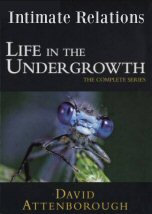
Intimate Relations

   2005    Nature
The world of invertebrates exists in a web of relationships with plants and other animals. Unique footage of the world's smallest insect (a fairy wasp only quarter of a millimetre long) shows it flying underwater to find the eggs of water beetles in which to lay its own brood. Some ants 'farm' the trees that give them shelter, creating areas known as 'Devil's gardens'. To make sure these grow without competition, they kill off other seedlings in the surrounding vegetation. The blister beetle's larvae huddle together on the end of a piece of grass and mimic a female bee. When a male bee tries to mate with the 'female', the larvae grab on to his belly. Confused, he flies away and searches for a real female. When he eventually finds her and mates with her, the beetle larvae hurriedly swap from his front on to her back, and hence get carried back to her nest where they eat her pollen supplies.
Series: Life in the Undergrowth

Zambezi

   2011    Nature
Africa's wildest river is home to the most spectacular wildlife. Hippos fight for territory while herds of elephant, water buffalo and zebra depend on it for life. In the wet season the rains burst the riverbanks and everyone, including people, must move whilst fish swim through the villages. In the dry season the creatures fight over the few pools of water while predators prowl. At its heart it plunges over Victoria Falls and into wild ravines before draining into the Indian Ocean, where storm clouds cycle the water back into the heart of Africa.
Series: Natural World

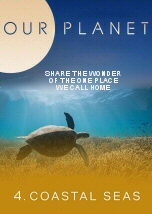
Coastal Seas

   2019    Nature    HD
Immense shoals of fish throng our shallow seas. Small fish, in turn, sustain bigger ones. The rich coastal seas are the fishing grounds of our planet and can provide an abundance of food for wildlife and humanity. The seas fringing land make up less than a tenth of the world's oceans but 90 percent of marine creatures live in coastal waters, from fearsome sharks to lowly urchins. Protecting these habitats is a battle humanity must win.
Series: Our Planet