Minerva B is a small rocky planet just like earth, where spacecraft Artemis has found water, organic molecules, and complex creatures. Is there something more to find? 'I am the mind of the spaceship, alone among the stars. 50 years ago, from a planet far away, the planet you call home, I launched. A journey of 28 trillion miles across the yawning time of space to the exoplanet, Minerva B: a small, rocky planet, much like Earth, but orbiting another sun. Here, I have found water, organic molecules, and microorganisms. When the news of my discovery reaches Earth years from now, some of you will be amazed. But others will remain unsatisfied, and you will ask, have I not found animals or birds? Have I not met intelligent life like us? And so, my search continues. I will find life of marvellous complexity, and the traces of a devastating loss.'
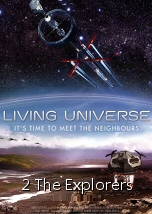
A look at the probes which explored our Solar System, laying the groundwork for a future spacecraft to search for life on a second Earth. That space craft must communicate, it must navigate, it must have power, it must have propulsion. We will have to give it all the intelligence necessary to make its own decisions. In 'The Explorers' the spacecraft Artemis initiates launch sequence and begins its 4.7 light year journey to Minerva B - an Earth-like exoplanet.
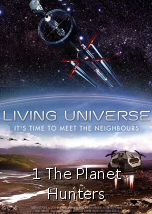
The next great voyage of human exploration has already begun: the search for life on planets orbiting distant stars. With extraordinary CGI, the world's most inspiring scientists, via extreme environments on Earth and around the solar system, the film takes viewers aboard the next generation of space ships, across the cosmos and beneath the clouds of the exo-planets to discover The Living Universe. Part 1: 'The Planet Hunters' For as long as we’ve had eyes to see and minds to wonder we’ve marveled at the stars. Since the discovery of the first so-called exoplanet in 1994, the Planet Hunters have transformed the way we see the universe. It is the year 2157, and spacecraft Artemis enters the final phase of construction.
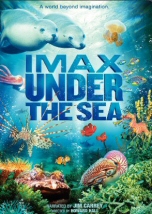
Experience up-close encounters with some of the most remarkable marine life ever captured on film while examining the impact of global climate change on the ocean wilderness as award-winning director/cinematographer Howard Hall travels from South Australia to the Indo-Pacific to teach viewers the importance of keeping our oceans clean for future generations. Just how great of an effect does global warming have on marine wildlife, and what can be done to ensure the future well-being of our planet? As the filmmakers reveal the delicacy of our fragile ecosystem, viewers are allowed the unique opportunity to see what we risk losing should we fail to address the issue of global climate change sooner rather than later.
Having explained the science behind global warming, and addressed the arguments of the climate change sceptics earlier in the series, Dr Iain Stewart concludes the series by looking at the biggest challenge now facing climate scientists - Just how can they predict exactly what changes global warming will bring? It's a journey that takes him from early attempts to model the climate system with dishpans, to supercomputers, and to the frontline of climate research today: Greenland. Most worryingly he discovers that scientists are becoming increasingly concerned that their models are actually underestimating the speed of changes already underway.
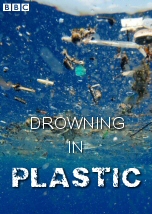
Our blue planet is facing one its biggest threats in human history. Trillions of pieces of plastic are choking the very lifeblood of our earth, and every marine animal, from the smallest plankton to the largest mammals, is being affected. But can we turn back this growing plastic tide before it is too late? Wildlife biologist Liz Bonnin visits scientists working at the cutting edge of plastics research. She works with some of the world's leading marine biologists and campaigners to discover the true dangers of plastic in our oceans and what it means for the future of all life on our planet, including us. Liz travels to a remote island off the coast of Australia that is the nesting site for a population of seabirds called flesh-footed shearwaters. Newly hatched chicks are unable to regurgitate effectively, so they are filling up on deadly plastic. She visits the Coral Triangle that stretches from Papua New Guinea to the Solomon Islands to find out more from top coral scientists trying to work out why plastic is so lethal to the reefs, fragile ecosystems that contain 25 per cent of all marine life.









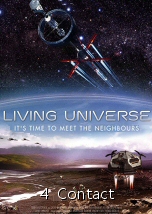





'I am the mind of the spaceship, alone among the stars. 50 years ago, from a planet far away, the planet you call home, I launched. A journey of 28 trillion miles across the yawning time of space to the exoplanet, Minerva B: a small, rocky planet, much like Earth, but orbiting another sun. Here, I have found water, organic molecules, and microorganisms. When the news of my discovery reaches Earth years from now, some of you will be amazed. But others will remain unsatisfied, and you will ask, have I not found animals or birds? Have I not met intelligent life like us? And so, my search continues. I will find life of marvellous complexity, and the traces of a devastating loss.'