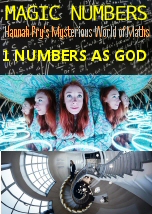
Dr Hannah Fry travels down the fastest zip wire in the world to learn more about Newton's ideas on gravity. His discoveries revealed the movement of the planets was regular and predictable. James Clerk Maxwell unified the ideas of electricity and magnetism, and explained what light was. As if that wasn't enough, he also predicted the existence of radio waves. His tools of the trade were nothing more than pure mathematics. All strong evidence for maths being discovered. But in the 19th century, maths is turned on its head when new types of geometry are invented. No longer is the kind of geometry we learned in school the final say on the subject. If maths is more like a game, albeit a complicated one, where we can change the rules, surely this points to maths being something we invent - a product of the human mind. To try and answer this question, Hannah travels to Halle in Germany on the trail of perhaps one of the greatest mathematicians of the 20th century, Georg Cantor. He showed that infinity, far from being infinitely big, actually comes in different sizes, some bigger than others. This increasingly weird world is feeling more and more like something we've invented. But if that's the case, why is maths so uncannily good at predicting the world around us? Invented or discovered, this question just got a lot harder to answer.
Mathematician Dr Hannah Fry explores the mystery of maths. It underpins so much of our modern world that it's hard to imagine life without its technological advances, but where exactly does maths come from? Is it invented like a language or is it something discovered and part of the fabric of the universe? It's a question that some of the most eminent mathematical minds have been wrestling with. To investigate this question, Hannah goes head first down the fastest zip wire in the world to learn more about Newton's law of gravity, she paraglides to understand where the theory of maths and its practice application collide, and she travels to infinity and beyond to discover that some infinities are bigger than others. In this episode, Hannah goes back to the time of the ancient Greeks to find out why they were so fascinated by the connection between beautiful music and maths. The patterns our ancestors found in music are all around us, from the way a sunflower stores its seeds to the number of petals in a flower. Even the shapes of some of the smallest structures in nature, such as viruses, seem to follow the rules of maths. All strong evidence for maths being discovered. But there are those who claim maths is all in our heads and something we invented. To find out if this is true, Hannah has her brain scanned. It turns out there is a place in all our brains where we do maths, but that doesn't prove its invented. Experiments with infants, who have never had a maths lesson in their lives, suggests we all come hardwired to do maths. Far from being a creation of the human mind, this is evidence for maths being something we discover. Then along comes the invention of zero to help make counting more convenient and the creation of imaginary numbers, and the balance is tilted in the direction of maths being something we invented. The question of whether maths is invented or discovered just got a whole lot more difficult to answer
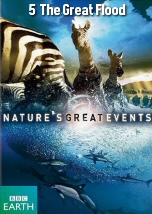
The great flood in the Okavango turns 4,000 square miles of arid plains into a beautiful wetland. Elephant mothers guide their families on an epic trek across the harsh Kalahari Desert towards it, siphoning fresh water from stagnant pools and facing hungry lions. Hippos battle for territory, as the magical water draws in thousands of buffalo and birds, and vast clouds of dragonflies. Will the young elephant calves survive to reach this grassland paradise? The experienced mother elephants time their arrival at the delta to coincide with the lush grass produced by the great flood. In a TV first, the programme shows the way they use their trunks to siphon clean water from the surface layers of a stagnant pool, while avoiding stirring up the muddy sediment on the bottom with their feet. Lechwe swamp deer, zebras, giraffes, crocodiles and numerous fish and thousands of birds arrive in the delta. And, in a phenomenon never before filmed in the Okavango, thousands of dragonflies appear - seemingly from nowhere - within minutes of the flood arrival, mating and laying eggs. As the flood finally reaches its peak, elephants and buffalo, near the end of their epic trek across the desert, face the final gauntlet of a hungry pride of lions. In a heart-wrenching sequence, a baby elephant is brought down by a lion in broad daylight.
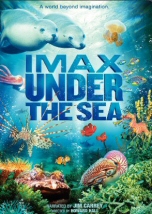
Experience up-close encounters with some of the most remarkable marine life ever captured on film while examining the impact of global climate change on the ocean wilderness as award-winning director/cinematographer Howard Hall travels from South Australia to the Indo-Pacific to teach viewers the importance of keeping our oceans clean for future generations. Just how great of an effect does global warming have on marine wildlife, and what can be done to ensure the future well-being of our planet? As the filmmakers reveal the delicacy of our fragile ecosystem, viewers are allowed the unique opportunity to see what we risk losing should we fail to address the issue of global climate change sooner rather than later.
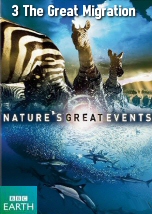
Each year more than one million wildebeest and zebra invade the Serengeti grasslands, making it a paradise for the predators that live there. But what happens when the herds move off again? We follow the moving story of one lion family's struggle to survive until the return of the great migration. Nature's Great Events tells the story of the epic trek of herds that follow the rains to fresh pastures, and the tale of the predators they leave behind. The crew captures the desperate plight of a single pride of lions, revealing a different side to the Serengeti. Rather than being a predators' paradise, it is a land in constant change, with wildebeest following the rains and leaving the lions to tough it out. The Ntudu pride has seven cubs, and is already suffering as the wildebeest leave to find fresh pastures. The four pride females struggle to find enough food for their hungry offspring. As weeks turn to months, the pride members become more emaciated and frailer, and the number of cubs dwindles to just two. As the herds begin to return, the plains reveal one final secret. For the first time since 1967 the Serengeti's only active volcano, Ol Doinyo Lengai, begins to billow ash and smoke. Filmed from the air, the team captures the exciting action. Fertilised by the volcanic ash over millions of years, these short grass plains are among the most productive grasslands in the world. After months of hardship, the pride's tragic story, through sickness, drought and fire, is over as the herds return, providing plentiful food.
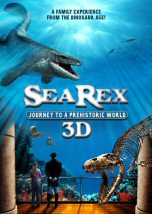
Experience a wondrous adventure from the dinosaur age. Join Julie, an imaginative young woman, as she travels from a modern-day aquarium to the Triassic, Jurassic and Cretaceous periods. Explore an amazing underwater universe inhabited by larger-than-life creatures including the powerful Liopleurodon, long-necked Elasmosaurus and gigantic Shonisaurus which were ruling the seas before dinosaurs conquered the earth. Thanks to state-of-the-art ultra-photorealistic imagery in 3D or 2D, see science come alive in a unique and entertaining manner. Immerse yourself in a lost age, 200 million years back in time, and get ready for a face-to-face encounter with the T-Rex of the seas. Directed by Ronan Chapalain and Pascal Vuong.











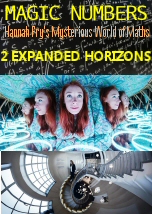



But in the 19th century, maths is turned on its head when new types of geometry are invented. No longer is the kind of geometry we learned in school the final say on the subject. If maths is more like a game, albeit a complicated one, where we can change the rules, surely this points to maths being something we invent - a product of the human mind. To try and answer this question, Hannah travels to Halle in Germany on the trail of perhaps one of the greatest mathematicians of the 20th century, Georg Cantor. He showed that infinity, far from being infinitely big, actually comes in different sizes, some bigger than others. This increasingly weird world is feeling more and more like something we've invented. But if that's the case, why is maths so uncannily good at predicting the world around us? Invented or discovered, this question just got a lot harder to answer.