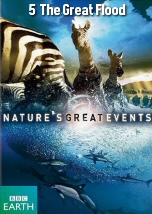
The great flood in the Okavango turns 4,000 square miles of arid plains into a beautiful wetland. Elephant mothers guide their families on an epic trek across the harsh Kalahari Desert towards it, siphoning fresh water from stagnant pools and facing hungry lions. Hippos battle for territory, as the magical water draws in thousands of buffalo and birds, and vast clouds of dragonflies. Will the young elephant calves survive to reach this grassland paradise? The experienced mother elephants time their arrival at the delta to coincide with the lush grass produced by the great flood. In a TV first, the programme shows the way they use their trunks to siphon clean water from the surface layers of a stagnant pool, while avoiding stirring up the muddy sediment on the bottom with their feet. Lechwe swamp deer, zebras, giraffes, crocodiles and numerous fish and thousands of birds arrive in the delta. And, in a phenomenon never before filmed in the Okavango, thousands of dragonflies appear - seemingly from nowhere - within minutes of the flood arrival, mating and laying eggs. As the flood finally reaches its peak, elephants and buffalo, near the end of their epic trek across the desert, face the final gauntlet of a hungry pride of lions. In a heart-wrenching sequence, a baby elephant is brought down by a lion in broad daylight.
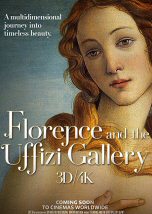
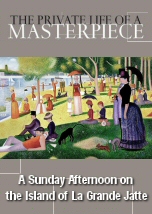
This award-winning series, Private Life of a Masterpiece, reveals the full and fascinating stories behind famous works of art, not just how they came to be created, but also how they influenced others and came to have a life of their own in the modern world. The works of art featured here are both instantly familiar and profoundly mysterious. Revolutionary in their conception, and iconic years after their execution, they each have their own compelling stories. For behind the beautiful canvases and sculptures are tales of political revolution, wartime escapes, massive ego clashes, social scandal, financial wrangling and shocking violence. In this fascinating series key works of art are investigated and the intricate details of their lives revealed - the history, contemporary reactions, and legacies of each are illustrated. A Sunday Afternoon on the Island of La Grande Jatte is a popular masterpiece and yet an enduring enigma. It seems to show a quiet scene in a Paris park but there are hints at the demi-monde, if you know where to look. The most remarkable aspect of this vast canvas however remains Seurat's technique his revolutionary pointillism.
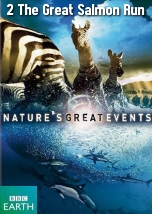
Every year grizzly bear families in North America depend for their survival on a spectacular natural event: the return of hundreds of millions of salmon from the Pacific Ocean to the mountain streams where they were born. The salmon travel thousands of miles to spawn and then die. The great run not only provides food for bears, but for killer whales, wolves, bald eagles, and even the forest itself. The question is: will the salmon return in time to keep hungry bears alive? A mother grizzly and her cubs emerge from their den high in snowy Alaskan mountains. Filming from the air the team capture a TV first, following the bears as they negotiate a near vertical slope on their journey to the coast where they await the return of the salmon. Meanwhile, the salmon are making their way to the to river mouths where they must swim upstream and against the current. The programme reveals how they tackle the torrents and leap over waterfalls, a feat equivalent to a human jumping over a house. Dozens of hungry bears eagerly await the salmon that make it up river. In another TV first, underwater cameras record the ingenuity and fancy footwork they use to collect dead salmon from the bottom of deep pools.
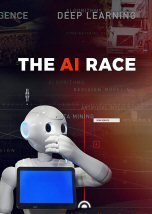
Explore how Artificial Intelligence will change your job as new research shows how much of what you do could be done by robots. From truckers to lawyers & doctors, we bring affected workers face to face with AI experts. How can we prepare for the coming changes to the world economy? We are on the precipice of another technological transformation. The last industrial revolution turned society upside down. It ultimately delivered greater prosperity and many more jobs, as well as the eight hour day and weekends.
But the transition was at times shocking and violent. The question is, can we do better this time? We don't realize that the future is not inevitable. The future is the result of the decisions we make today. These technologies are morally neutral, they can be used for good or for bad.
There's immense good things they can do, they can eliminate many disease,
they can help eliminate poverty, they can tackle climate change. Equally, the technology can be used for lots of bad. It can be used to increase inequality,it can be used to transform warfare. It can be used to make our lives much worse. We get to make those choices.
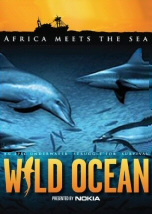
Each year an unbelievable feeding frenzy takes place in the oceans of South Africa as billions of sardines migrate up the KwaZulu-Natal Coast. Wild Ocean captures spectacular breaching whales, feeding sharks, diving gannets, and massive bait balls inside and up close on the screen. The migration has provided an annual food source for both life in the sea and the people living along the African shores for countless generations. The film demonstrates how business, government, and the local people have joined forces to protect this invaluable ecological resource. The film will delve audiences into an epic underwater struggle for survival and reveal the economic and cultural impact the migration has on the coastal communities. Wild Ocean is an explosive, symphonic documentary film about man and nature which captures one of natures greatest migration spectacles through the magic of IMAX.
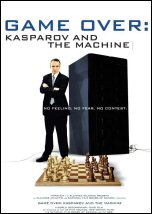
Professor Jim Al-Khalili looks at how we have created machines that can simulate, augment, and even outperform the human mind - and why we shouldn't let this spook us. He reveals the story of the pursuit of AI, the emergence of machine learning and the recent breakthroughs brought about by artificial neural networks. He shows how AI is not only changing our world but also challenging our very ideas of intelligence and consciousness.
Along the way, we'll investigate spam filters, meet a cutting-edge chatbot, look at why a few altered pixels makes a computer think it's looking at a trombone rather than a dog and talk to Demis Hassabis, who heads DeepMind and whose stated mission is to 'solve intelligence, and then use that to solve everything else'. Stephen Hawking remarked 'AI could be the biggest event in the history of our civilisation. Or the worst'. Jim argues that AI is a potent new tool that should enhance our lives, not replace us.








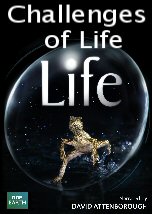


In a TV first, the programme shows the way they use their trunks to siphon clean water from the surface layers of a stagnant pool, while avoiding stirring up the muddy sediment on the bottom with their feet. Lechwe swamp deer, zebras, giraffes, crocodiles and numerous fish and thousands of birds arrive in the delta. And, in a phenomenon never before filmed in the Okavango, thousands of dragonflies appear - seemingly from nowhere - within minutes of the flood arrival, mating and laying eggs. As the flood finally reaches its peak, elephants and buffalo, near the end of their epic trek across the desert, face the final gauntlet of a hungry pride of lions. In a heart-wrenching sequence, a baby elephant is brought down by a lion in broad daylight.