



Last Watched

"AGI"  Sort by

Corruption

   2005    History
In the fourth episode of the series, eyewitnesses recall how those in power at Auschwitz lined their pockets with wealth stolen from Jewish inmates while also engaging in illicit affairs.
Series: Auschwitz The Nazis and the Final Solution
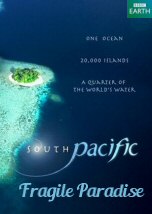

South Pacific Fragile Paradise

   2009    Nature
The extraordinary wildlife, culture and history of this immense, fascinating ocean and its myriad islands are revealed in stunning detail. With its coral reefs, turquoise lagoons and dramatic oceanic atolls, the South Pacific is the archetypal paradise. It is still relatively healthy and teeming with fish, but it is a fragile paradise. International fishing fleets are taking a serious toll on the sharks, albatross and tuna, and there are other insidious threats to these bountiful seas. We look at what is being done to preserve the ocean and its wildlife.

Are We Alone

   2011    Science
Aliens almost certainly do exist. So why haven't we yet met E.T.? It turns out we're only just developing instruments powerful enough to scan for them, and science sophisticated enough to know where to look. As a result, race is on to find the first intelligent aliens. But what would they look like, and how would they interact with us if we met? The answers may come to us sooner than we imagine, for one leading astronomer believes she may already have heard a hint of their first efforts to communicate
Series: Through the Wormhole

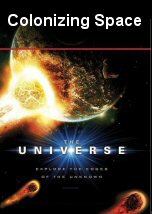
Colonizing Space

   2008    Technology
Space colonization is no longer the fodder of science fiction, it is becoming a reality. Examine the efforts underway to establish a human colony on Mars, including how they plan to grow food, recycle wastewater and introduce greenhouse gases to revive the red planet and make it more habitable for humans. Cutting-edge computer graphics are used to bring the universe down to earth to show what life would be like on Mars, and to imagine what kind of life forms might evolve in alien atmospheres.
Series: The Universe

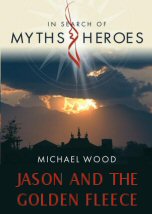
Jason and the Golden Fleece

   2005    History
The Greek tale of Jason and the Golden Fleece has been told for 3,000 years. It's a classic hero's quest tale - a sort of ancient Greek mission impossible - in which the hero embarks on a sea voyage into an unknown land, with a great task to achieve. He is in search of a magical ram's fleece, which he has to find in order to reclaim his father's kingdom of Iolkos from the usurper King Pelias. Michael Wood discovers a story of heroism, treachery, love and tragedy that would make Hollywood proud.
Series: Myths and Heroes

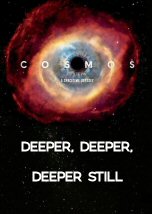
Deeper, Deeper, Deeper Still

   2014    Science
This episodes the nature of the cosmos on the micro and atomic scales, using the Ship of the Imagination to explore these realms. Tyson describes some of the micro-organism that live within a dew drop, demonstrating parameciums and tardigrades. He proceeds to discuss how plants use photosynthesis via their chloroplasts to convert sunlight into chemical reactions that convert carbon dioxide and water into oxygen and energy-rich sugars. Tyson then discusses the nature of molecules and atoms and how they relate to the evolution of species. He uses the example set forth by Charles Darwin postulating the existence of the long-tongued Morgan's sphinx moth based on the nature of the comet orchid with pollen far within the flower. He further demonstrates that scents from flowers are used to trigger olfactory centers in the brain, stimulating the mind to threats as to aid in the survival of the species. Tyson narrates how Greek philosophers Thales and Democritus postulated that all matter was made up of combinations of atoms in a large number of configurations, and describes how carbon forms the basic building block for life on earth due to its unique chemical nature. Tyson explains on the basic atomic structure of protons, neutrons, and electrons, and the nature of nuclear fusion that occurs in most stars. He then discusses the existence of neutrinos that are created by these nuclear processes in stars, and that detecting such sub-atomic particles which normally pass through matter require subterranean facilities like the Super-Kamiokande that were used to detect neutrinos from the supernova SN 1987A in the Large Magellanic Cloud before light from the explosion were observed due to their ability to pass through matter of the dying sun. Tyson compares how neutrinos were postulated by Wolfgang Pauli to account for the conservation of energy from nuclear reactions in the same manner as Darwin's postulate on the long-tongued moth. Tyson concludes by noting that there are neutrinos from the Big Bang still existing in the universe but due to the nature of light, there is a "wall of infinity" that cannot be observed beyond.
Series: Cosmos: A Spacetime Odyssey
Wild Isles

Wild Isles

2023  Nature
The Last Dance

The Last Dance

2020  Culture
Blood of the Vikings

Blood of the Vikings

2001  History
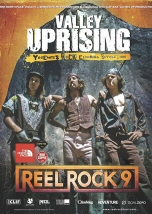
Reel Rock

Reel Rock

2014  Culture