



Last Watched

"Earth"  Sort by

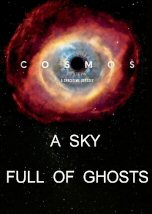
Cosmos: A Spacetime Odyssey. Standing Up in the Milky Way

   2014    Science    HD
Famed astrophysicist Neil deGrasse Tyson takes a tour of the Solar System and the known universe establishing the components of Earth's "address" within the Virgo Supercluster. He then shares the story of the person who championed an expansive understanding of Earth's place in the universe by presenting Renaissance Italian Giordano Bruno's vision of the universe as a limitless expanse of space and time. He then makes an exploration into the Cosmic Calendar, which dates back to the dawn of the Big Bang (similar to the presentation from episode 1 of the original series). The episode ends with deGrasse Tyson narrating how he met his mentor Carl Sagan, who hosted the first Cosmos series.
Series: Cosmos: A Spacetime Odyssey
Colours of Life

   2015    Science
Earth is the most colourful place we know of. But the colours we see are far more complex and fascinating than they appear. In this series, Dr Helen Czerski uncovers what colour is, how it works, and how it has written the story of our planet - from the colours that transformed a dull ball of rock into a vivid jewel to the colours that life has used to survive and thrive". But the story doesn't end there - there are also the colours that we can't see, the ones that lie beyond the rainbow. Each one has a fascinating story to tell. Early Earth was a canvas for the vast new palette of the colours of life, with the diversity of human skin tones telling the story of how humanity spread and ultimately conquered the planet. Dr Helen Czerski explores the true masters of colour - which are often the smallest and most elusive - travelling to the mountains of Tennessee to witness the colourful mating display of fireflies, and revealing the marine creatures that can change the colour of their skin in order to hide from the world.
Series: Colour The Spectrum of Science

The Immortals

   2014    Science
This episode covers the nature of how life may have developed on Earth and the possibility of life on other planets. Tyson begins by explaining how the human development of writing systems enabled the transfer of information through generations, describing how Princess Enheduanna ca. 2280 BCE would be one of the first to sign her name to her works, and how Gilgamesh collected stories, including that of Utnapishtim documenting a great flood comparable to the story of Noah's Ark. Tyson explains how DNA similarly records information to propagate life, and postulates theories of how DNA originated on Earth, including evolution from a shallow tide pool, or from the ejecta of meteor collisions from other planets. In the latter case, Tyson explains how comparing the composition of the Nakhla meteorite in 1911 to results collected by the Viking program demonstrated that material from Mars could transit to Earth, and the ability of some microbes to survive the harsh conditions of space. With the motions of solar systems through the galaxy over billions of years, life could conceivably propagate from planet to planet in the same manner. Tyson then moves on to consider if life on other planets could exist. He explains how Project Diana performed in the 1960s showed that radio waves are able to travel in space, and that all of humanity's broadcast signals continue to radiate into space from our planet. Tyson notes that projects have since looked for similar signals potentially emanating from other solar systems. Tyson then explains that the development and lifespan of extraterrestrial civilizations must be considered for such detection to be realized. He notes that civilizations can be wiped out by cosmic events like supernovae, natural disasters such as the Toba disaster, or even self-destruct through war or other means, making probability estimates difficult. Tyson describes how elliptical galaxies, in which some of the oldest red dwarf stars exist, would offer the best chance of finding established civilizations. Tyson concludes that human intelligence properly applied should allow our species to avoid such disasters and enable us to migrate beyond the Earth before the Sun's eventual transformation into a red giant.
Series: Cosmos: A Spacetime Odyssey
Ice Worlds

   2007    Nature
The Arctic and Antarctic experience the most extreme seasons on Earth. Time-lapse cameras watch a colony of emperor penguins, transforming them into a single organism. The film reveals new science about the dynamics of emperor penguin behaviour. In the north, unique aerial images show a polar bear swimming more than 100km. Diving for up to two minutes at a time. The exhausted polar bear later attacks a herd of walrus in a true clash of the Titans.
Series: Planet Earth

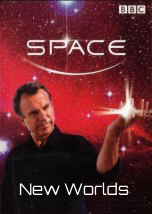
New Worlds

   2001    Nature
Sam Neill explores humanity's long-term future - a future where we make new homes for ourselves on other worlds as we flee from the slow but inevitable death of our sun.
Series: Space

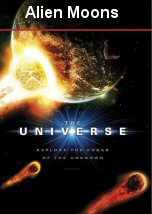
Alien Moons

   2007    Science
Travel from the inner solar system to the Kuiper Belt and explore the moons surrounding the planets of the solar system. Many of these moons that were once unknown are now on the cutting edge of astronomical study. Some burst with volcanic fury another spews icy geysers and others offer the possibility of alien life. Are these strange worlds simply hostile environments unfit for humans or do other possibilities exist? Cutting-edge computer graphics are used to bring the universe down to earth and to imagine what kind of life forms might evolve in alien atmospheres.
Series: The Universe
Out of the Cradle

Out of the Cradle

2019  History
History of the Eagles

History of the Eagles

2013  History
The Last Dance

The Last Dance

2020  Culture
Human

Human

2025  History
Beyond the Elements

Beyond the Elements

2020  Science
The Universe

The Universe

2007  Science
Planet Earth

Planet Earth

2007  Nature