Almost everything we know today about the beautiful giant ringed planet comes from Cassini, the NASA mission that launched in 1997 and arrived at Saturn in 2004. Since then, the space probe has been beaming home miraculous images and scientific data, revealing countless wonders about the planet, its rings and 62 moons - including some that could harbor life. When the mission approached its final days, it attempted one last set of daring maneuvers - diving between the innermost ring and the top of Saturn's atmosphere. Aiming to skim less than 2000 miles above the cloud tops, no spacecraft has ever gone so close to Saturn, and hopes were high for incredible observations that could solve major mysteries about the planet's core. But such a daring maneuver comes with many risks and is no slam dunk. In fact, slamming into rocks in the rings is a real possibility. Join NASA engineers for the tense and triumphant moments as they find out if their bold re-programming has worked, and discover the wonders that Cassini has revealed over the years.
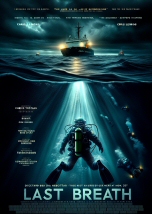
A deep sea diver is stranded on the seabed with 5 minutes of oxygen and no hope of rescue. With access to amazing archive this is the story of one man's impossible fight for survival. Chris Lemons were carrying out repairs 100m below the surface of the North Sea, supported by the vessel Bibby Topaz. The vessel's dynamic positioning system failed, causing it to snap the umbilical tether that provided Lemons oxygen, as well as hot water to heat his suit, power for his light, and a radio link to the surface. He was left with only the few minutes of breathable gas contained in the cylinders he wore on his back. For reasons that are unclear, Lemons survived for around 30 minutes while he was located by a remote underwater vehicle and then by Yuasa, who was able to pull him back onboard the diving bell. The documentary uses genuine footage and audio recorded at the time of the accident on the divers' radios and body cameras, supplemented with interviews of several of the individuals involved, as well as some reconstructed footage, to tell the story of the accident.
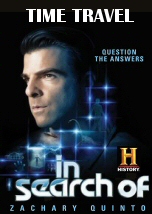
Zachary Quinto charts a journey to determine whether time travel is possible. He meets a man who claims to have traveled back in time due to a secret government program and a group of people living in Liverpool known as 'time slippers'. Zachary makes a visit to the CERN headquarters in Geneva, where he attempts to understand the origins of the universe and the dimension of time. Equipped with this new knowledge, Zachary tests his own perception of time with an elaborate skydiving experiment to see if he can slow down time itself.
Located beneath Russia's Ural Mountains, Orda Cave is legendary among divers for its unique beauty. The cave's waters are clearest in winter, when the land above lies frozen. With temperatures approaching minus 40 degrees, NHK attempts to film the cave for the first time ever using 4K cameras. Scientists give them insight into the cave's origins, enabling the crew to uncover the miraculous story of how the cave was naturally formed 300 million years ago by climate change and a shifting landscape.
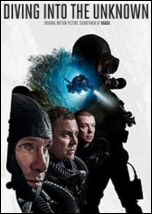
(Click CC for English subtitles) Four Finnish cave divers face their worst nightmare when two of their friends drown deep inside an underwater cave in Norway. When the official recovery operation is called off by the Norwegian and British authorities after being deemed too risky, the friends set out on a secret mission to retrieve the bodies themselves. "Diving into the Unknown" isn’t just the dramatic story of a life-threatening mission. It is also a story about unconditional friendship that truly runs deep. While each member of the team has years of experience exploring dangerous deep-sea caves, together they are about to face the biggest challenge of their lives. To make it out alive, they will need to be able to rely on each other every second of the way. And the physical demands of this operation will pale in comparison to the psychological toll it will take on everyone involved.
With footage from the actual accident and multiple cameras both above water and deep below the surface, this film follows the breathtaking recovery mission from beginning to end.
Spy in the Huddle use innovative techniques to reveal the incredible secrets of your pets' behaviour in ways never seen before. As astonishing photography explores the wild side of our playful pets, find out why hamsters love to run in a wheel, how dogs pick up the rules of the pack and how kittens learn to be solitary hunters. Featuring incredible views of plunge-diving dogs, babysitting cats, acrobatic hamsters and a playful cat outwitted by his prey" - you'll never look at your favourite companions in quite the same way again. The latest science also reveals why budgies talk, how a cat scales a vertical wall with the help of a special claw, why hamsters stuff their faces with more food than they can eat and the real meaning behind a rabbit's hop. Our pets are also given a chance to explore their wild side as we join the free-roaming pet dogs of Cusco Peru, pet rabbits living in a natural warren and the wild-living inhabitants of Cat Island, Japan. A range of innovative techniques such as moving X-rays, thermal imagery, minicam-carrying dogs and revelatory slow-motion photography shows why our pets play and how their true wild nature is just a whisker away.












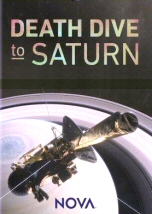









Aiming to skim less than 2000 miles above the cloud tops, no spacecraft has ever gone so close to Saturn, and hopes were high for incredible observations that could solve major mysteries about the planet's core. But such a daring maneuver comes with many risks and is no slam dunk. In fact, slamming into rocks in the rings is a real possibility. Join NASA engineers for the tense and triumphant moments as they find out if their bold re-programming has worked, and discover the wonders that Cassini has revealed over the years.