


Last Watched

"Ant"  Sort by

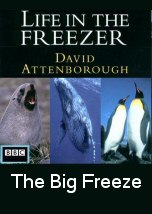
The Big Freeze

   1993    Nature
As almost all animal inhabitants of Antarctica are forced to migrate north, the sea underneath the frozen ice still provides a home to many specially adapted fish whose cells are protected from freezing through an 'antifreeze' liquid. Many of them feed on the faeces of other animals. The most notable larger animal that does not migrate north is perhaps the Weddell Seal, which can be found as close as 1300 kilometres to the pole. Groups of seals tear holes into the ice to dive for food and come up to breathe. The females come back to the ice to give birth. This episode also describes primitive plant life such as lichen, which can still be found on the continent in winter, even in the extremely dry and permanently frozen valleys conditions under which dead animals can lie frozen for many centuries without decomposing. It details the life of the Emperor Penguin, 'the only birds to lay their eggs directly on ice'. While other animals retreat, Emperors migrate not just to the ice, but into the Antarctic continent. The females lay eggs which are incubated by the males under the harshest conditions on Earth (huddling closely together for warmth), while the females return to the sea.
Series: Life in the Freezer
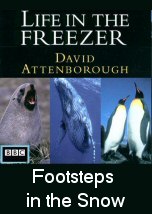
Footsteps in the Snow

   1993    History
This episode discusses the human exploration of Antarctica, in particular the mission led by Captain Robert Falcon Scott, whose team died on the way back from the South Pole. It shows the scientific work in the modern human bases in Antarctica, especially Mawson Base and its observation of Adelie Penguins (partially through tracking devices). The second half of the episode describes how the series was made. Most crucial was of course the camera work. To get access to the wildlife of the sea, for example, boats, divers, suspended capsules and remotely controlled cameras mounted on inflatables were used. Particularly dangerous to divers were Leopard Seals and other predators. The film concludes that although working in Antarctica is now much easier than during the early days of exploration, human footsteps on the continent are still exceedingly rare in part because of international treaties prohibiting industrial exploitation.
Series: Life in the Freezer

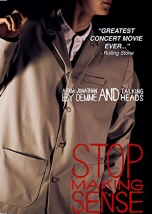
Stop Making Sense

   1984    Art
Over the course of three nights at Hollywood's Pantages Theater in December 1983, filmmaker Jonathan Demme joined creative forces with Jordan Cronenweth and Talking Heads... and miracles occurred. Following a staging concept by singer-guitarist David Byrne, this euphoric concert film transcends that all-too-limited genre to become the greatest film of its kind. A guaranteed cure for anyone's blues, it's a celebration of music that never grows old, fueled by the polyrhythmic pop-funk precision that was a Talking Heads trademark, and lit from within by the geeky supernova that is David Byrne.
This circus of musical pleasure defies the futility of reductive description; it begs to be experienced, felt in the heart, head, and bones, and held there the way we hold on to cherished memories. On those three nights in December 1983, Talking Heads gave love, life, and joy in generous amounts that years cannot erode, and Demme captured this act of creative goodwill on film with minimalist artistic perfection. Stop Making Sense is an invitation to pleasure that will never wear out its welcome.

Heaven and Hell

   1980    Science
Sagan discusses comets and asteroids as planetary impactors, giving recent examples of the Tunguska event and a lunar impact described by Canterbury monks in 1178. It moves to a description of the environment of Venus, from the previous fantastic theories of people such as Immanuel Velikovsky to the information gained by the Venera landers and its implications for Earth's greenhouse effect. The Cosmos Update highlights the connection to global warming.
Series: Cosmos

Travellers Tales

   1980    Science
The journeys of the Voyager probes is put in the context of the Netherlands in the seventeenth century, with a centuries-long tradition of sailing ship explorers, and its contemporary thinkers (such as Constantijn Huygens and his son Christian). Their discoveries are compared to the Voyager probes' discoveries among the Jovian and Saturn systems. In Cosmos Update, image processing reconstructs Voyager’s worlds and Voyager’s last portrait of the Solar System as it leaves is shown.
Series: Cosmos

The Lives of the Stars

   1980    Science
The simple act of making an apple pie is extrapolated into the atoms and subatomic particles (electrons, protons, and neutrons) necessary. Many of the ingredients necessary are formed of chemical elements formed in the life and deaths of stars (such as our own Sun), resulting in massive red giants and supernovae or collapsing into white dwarfs, neutron stars, pulsars, and even black holes. These produce all sorts of phenomena, such as radioactivity, cosmic rays, and even the curving of spacetime by gravity. Cosmos Update mentions the supernova SN 1987A and neutrino astronomy.
Series: Cosmos
Rise of Empires: Ottoman

Rise of Empires: Ottoman

2020  History
Zeitgeist

Zeitgeist

2007  Culture
Speed

Speed

2019  Technology
Out of the Cradle

Out of the Cradle

2019  History
All or Nothing: Arsenal

All or Nothing: Arsenal

2022  Culture
The Virtual Revolution

The Virtual Revolution

2010  Technology
Mind Field Season 1

Mind Field Season 1

2017  Medicine