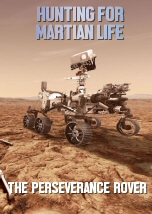
Meet Perseverance, NASA's latest rover, as it heads to Mars to answer one question: did life exist on the red planet? On the way, it will lay the foundation for human exploration of our closest neighbour. Today, Mars is hostile to life. It's too cold for water to stay liquid on the surface, and the thin atmosphere lets through high levels of radiation, potentially sterilizing the upper part of the soil. But it wasn't always like this. Some 3.5 billion years ago or more, water was flowing on the surface. It carved channels still visible today and pooled in impact craters. A thicker carbon dioxide atmosphere would have blocked more of the harmful radiation. The Mars 2020/Perseverance rover is designed to better understand the geology of Mars and seek signs of ancient life. The mission will collect and store a set of rock and soil samples that could be returned to Earth in the future. It will also test new technology to benefit future robotic and human exploration of Mars, as the Ingenuity Helicopter.
In these extraordinary times, there is one thing that can offer solace to everyone – the wonder of the natural world. In the most extreme of environments, from the hottest deserts to the freezing poles, from the highest mountains to underwater kingdoms, animals overcome adversity to survive and thrive, offering a message of hope to humanity. To raise our spirits, David Attenborough, Hans Zimmer and Dave unite for a special Natural History event – Planet Earth: A Celebration. The special one-hour programme brings together eight of the most extraordinary sequences from Planet Earth II and Blue Planet II including racer snakes vs iguana, surfing bottlenose dolphins and rare footage of the Himalayan snow leopard.
In a provocative documentary, environmental campaigner George Monbiot examines the disastrous impact that farming animals for meat has had on the planet. He argues that the biggest problem driving us towards global disaster is how we feed ourselves, particularly on meat George looks at alternative food sources, including synthetic meat, and a process that produces protein from just bacteria and air, and also explores revolutionary ideas that could change agriculture as we know it.
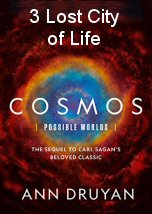
Episode 3 delves into how life began on a roiling, violent Earth and explores the story behind Victor Goldschmidt, the man who found the first clues to life's beginnings on our planet. Neil deGrasse Tyson takes viewers on a journey through space and time to witness the tenacity and creativity of life on Earth and the prospects of life throughout the universe.
Inside the heart of the atom, its nucleus houses energy. This hidden treasure was forged billions of years ago in distant stellar furnaces. The secret of starlight is nothing to fool with. It can bring a civilization to life and it can burn it to the ground. Two atoms from different parts of the universe meet on a small planet. A deadly embrace between science and state altered the fate of the world and a gripping cautionary tale of others who grew used to living in the shadow of grave danger until it killed them all except one.
Five times, the Earth has faced apocalyptic events. Cataclysms that have swept away all life forms, or almost. Each time, a handful of species has survived, establishing a new world. What did these prehistoric worlds look like? What catastrophes led to their disappearance? How did our distant ancestors manage to survive the five mass extinctions that the Earth has suffered, finally giving rise to the world we know today? Combining CGI of ancient animal and plant life, VFX and filming, 'Prehistoric Worlds' looks back at the five mass extinctions of life on Earth that allowed the advent of the human race. On the brink of a sixth mass extinction that the scientific community considers imminent – this time caused by mankind – this film gives us an interesting and powerful look at Man's existence on the scale of the history of our planet.


























Today, Mars is hostile to life. It's too cold for water to stay liquid on the surface, and the thin atmosphere lets through high levels of radiation, potentially sterilizing the upper part of the soil. But it wasn't always like this. Some 3.5 billion years ago or more, water was flowing on the surface. It carved channels still visible today and pooled in impact craters. A thicker carbon dioxide atmosphere would have blocked more of the harmful radiation. The Mars 2020/Perseverance rover is designed to better understand the geology of Mars and seek signs of ancient life. The mission will collect and store a set of rock and soil samples that could be returned to Earth in the future. It will also test new technology to benefit future robotic and human exploration of Mars, as the Ingenuity Helicopter.