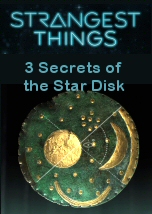
An ancient bronze disk adorned with gold may contain the oldest images of the cosmos ever discovered; using new research and the latest tech, experts investigate if this artefact could be the work of a prehistoric astrologer. Is it just a decorative disc or is there some hidden meaning? A strange 11,000-year-old deer skull can have links to a British Atlantis.
An ancient piece of corroded metal is more than it seems: an alien-looking device of intricate dials and cogs; there are over 30 gears inside and some gears have up to 65 teeth on them. Using cutting-edge imaging technology, experts examine what could actually be a 2,000-year-old computer. How can an ancient Roman cup change colour? It's not an optical illusion. It really does change colour from red to green.
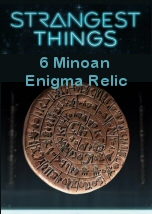
The Phaistos Disc is one of the greatest mysteries of the Bronze Age. A strange 3,000-year-old relic found in an ancient Minoan palace marked with enigmatic images that no one has ever managed to decode. But now, using cutting-edge technology, experts might finally reveal its secrets. How can this corroded scrap of metal change the history of a continent? And is this dead woman's face the most kissed in history?
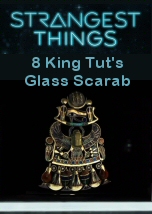
The jeweled-encrusted pectoral of King Tut is a hieroglyphic artefact of stunning craftsmanship and one of the greatest treasures of the pharaohs. Was this ancient glass scarab in Tutankhamun's tomb created by forces from beyond our world? Using new research and the latest tech, experts confront the ancient mystery of its flawless glass scarab. Is a 4,000 year old clay tablet the original instruction manual for Noah's ark? And how can a bizarre red moon rock contain signs of life?
How did the universe come to be? Thanks to a series of discoveries, our most powerful space missions have unravelled 13.8 billion years of cosmic evolution and revealed the story of our universe from its birth all the way to the arrival of our nascent civilization. Our guide on this odyssey back to the dawn of time is light. Telescopes are time machines - by looking out into the distant universe, they open a window to the past. One telescope more than any other has helped us journey through the history of the universe: NASA’s Hubble Space Telescope. Remarkably, Hubble has even found one of the first galaxies ever to exist in the universe, which was born some 13.4 billion years ago. It's a discovery that hints at the beginnings of our own Milky Way. Vivid CGI brings this ancient galaxy to life, allowing us to witness for ourselves the first dawn. It was the beginning of a relationship between stars and planets that would, on a faraway world, lead to the origin of life - and ultimately to us. Hubble’s incredible discoveries have allowed scientists to piece together much of our cosmic story, but it cannot take us back to the most important moment in history: the Big Bang. For decades, the moment the universe began was the subject of pure speculation, but by combining astronomy and cosmology, scientists have finally found a way to put their theories to the test and study the momentous events that took place during the Big Bang. They can do this because the European Space Agency’s Planck space telescope has seen the afterglow of the Big Bang itself – something we call the Cosmic Microwave Background. The unparalleled detail Planck gave us has helped confirm something remarkable: the Big Bang may not be the beginning. There was a time before the dawn – a place beyond anything we can comprehend. Professor Brian Cox transports us back to the fraction of a second before the Big Bang, when the seeds of our universe were planted.
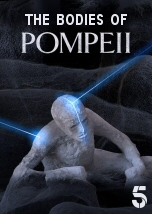
It's 79 AD and Mount Vesuvius is about to blow. In 24 hours time, the people of Pompeii and Herculaneum are going to die. They will be part of the death toll of one of the worst natural disasters in history. Starting with a forensic examination of their remains, Bettany Hughes pieces together the final 24 hours of their lives in incredible detail.













A strange 11,000-year-old deer skull can have links to a British Atlantis.