










Last Watched

"Earth"  Sort by

Evolution: Great Transformations

   2004    Science
What triggered the incredible diversity of life on Earth, and how have complex life forms, including humans, evolved? Is there direction to evolution? And is human intelligence inevitable? This program focuses on evolution's 'great transformations' —among them the development of a standard four-limbed body plan, the journey from water to land, the return of marine mammals to the sea, and the emergence of humans. Driven by a combination of opportunism and a genetic 'toolkit', these astounding leaps forward define the arc of evolution. And they suggest that every living creature on earth today, and every species that has ever existed, is a variation on a grand genetic theme—a member of one, and only one, tree of life
Series: Evolution

Evolution: The Evolutionary Arms Race

   2004    Science
Survival of the fittest: Raw competition? Intense cooperation? Both are essential. Interactions between and within species are among the most powerful evolutionary forces on Earth, and understanding them may be a key to our own survival.
Series: Evolution

New Worlds

   2001    Nature
Sam Neill explores humanity's long-term future - a future where we make new homes for ourselves on other worlds as we flee from the slow but inevitable death of our sun.
Series: Space

Moon

   2000    Science
The little known story of our quest to understand the origins of the Moon. Neil Armstrong's "giant leap for mankind" began a scientific journey of discovery that lead to one of the most startling conclusions in the history of astronomy. The Moon was born from Earth.
Series: The Planets

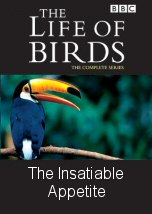
The Insatiable Appetite

   1998    Nature
The next instalment focuses on dietary needs and how different species have evolved beaks to suit their individual requirements. The latter come in a multitude of forms. Blue tits and goldfinches have beaks akin to tweezers, with which to extract seeds, while the hawfinch's razor-like bill can deal with a cherry-stone. However, the crossbill is the only finch that can twist its mandibles in opposite directions. Jays store acorns for winter by burying them in the ground, whereas woodpeckers can keep up to 60,000 of them in one tree trunk. Sap is also desirable, and there are a variety of methods used to obtain it. The hoatzin is the only specialised leaf-eater, and accordingly has a digestive system more akin to that of cattle. Plants recruit birds to aid pollination, and offer nectar as a reward. Hummingbirds eat little else, and the sword-bill's beak is the longest of any bird in relation to its body. Insects are also highly prized, and Galapagos finches are shown to possess some ingenuity as they not only strip bark, but also use 'tools' to reach their prey. Crows are hailed as being among the most intelligent birds, and one is shown using a twig to spear a grub within a fallen log. The robin is an opportunist, and Sir Attenborough observes one seizing morsels as he digs a patch of earth. In South America, a cattle tyrant sits atop an obliging capybara and uses its vantage point to spot passing food that may be dislodged by its grazing partner.
Series: The Life of Birds

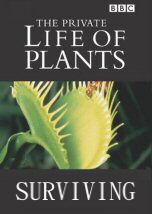
Surviving

   1995    Nature
the final episode deals with plants that live in hostile environments. Attenborough visits Ellesmere Island, north of the Arctic Circle, to demonstrate that even in a place that is unconducive to life, it can be found. Algae and lichens grow in or on rock, and during summer, when the ice melts, flowers are much more apparent. However, they must remain close to the ground to stay out of the chilling wind. In the Tasmanian mountains, plants conserve heat by growing into 'cushions' that act as solar panels, with as many as a million individual shoots grouped together as one. Others, such as the lobelia in Mount Kenya, have a 'fur coat' of dense hairs on their leaves. The saguaro cactus in the Sonoran Desert flourishes because of its ability to retain vast amounts of water, which can't be lost through leaves because it has none. Many desert dwellers benefit from an accelerated life cycle, blooming rapidly within weeks after rainfall. Conversely, Mount Roraima is one of the wettest places on Earth. It is a huge sandstone plateau with high waterfalls and nutrients are continuously washed away, so plants have to adapt their diet if they are to survive. A bladderwort is shown invading a bromeliad. Inhabitants of lakes have other problems to contend with: those that dominate the surface will proliferate, and the Amazon water lily provides an apt illustration. Attenborough ends the series with an entreaty for the conservation of plant species.
Series: The Private Life of Plants