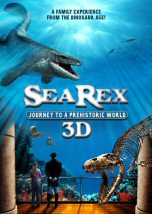
Experience a wondrous adventure from the dinosaur age. Join Julie, an imaginative young woman, as she travels from a modern-day aquarium to the Triassic, Jurassic and Cretaceous periods. Explore an amazing underwater universe inhabited by larger-than-life creatures including the powerful Liopleurodon, long-necked Elasmosaurus and gigantic Shonisaurus which were ruling the seas before dinosaurs conquered the earth. Thanks to state-of-the-art ultra-photorealistic imagery in 3D or 2D, see science come alive in a unique and entertaining manner. Immerse yourself in a lost age, 200 million years back in time, and get ready for a face-to-face encounter with the T-Rex of the seas. Directed by Ronan Chapalain and Pascal Vuong.
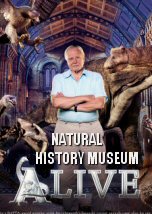
In this ground-breaking film, Sir David Attenborough takes us on a journey through the world-famous Natural History Museum in London in a captivating tale of discovery, adventure, and magic, where state-of-the-art CGI, science, and research combine to bring the museum's now long-extinct inhabitants to life to discover how these animals once roamed the planet. As the doors are locked and night falls, Attenborough stays behind and meets some of the most fascinating extinct creatures which come alive in front of his eyes; dinosaurs, ice age beasts, and giant reptiles. The film fulfils a lifelong dream of him, who said: 'I have been coming to the Natural History Museum since I was a boy. It's one of the great places to come to learn about natural history. In this film we have the technology to bring back to life some of the most romantic and extraordinary extinct creatures that can be conceived; some are relatively recent animals like the dodo, others older like the dinosaurs, and some we only know through fossil evidence. Using our current scientific knowledge, this film brings these creatures alive, allowing me to look at some of the biggest questions surrounding them.'
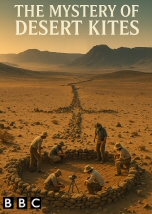
Across the Arabian desert stretch mysterious stone structures, vast kite -shaped formations that have baffled scientists for generations. An international team of archaeologists now sets out to uncover their secrets, combining cutting-edge technology with traditional fieldwork to piece together clues buried beneath the sands. Their discoveries suggest that these enigmatic megastructures may have been used for hunting, ritual, or social gatherings—evidence of a sophisticated culture that thrived thousands of years before the pyramids. From Saudi Arabia’s rugged plateaus to Jordan’s Black Desert, each site reveals astonishing traces of human ingenuity and survival. Sweeping aerial vistas and gripping on-site discoveries immerse us in a mystery that challenges established timelines and forces us to reconsider how early civilizations shaped their world.
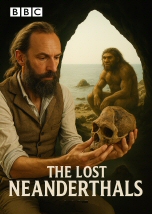
In the heart of southern France, the Mandrin Cave has drawn archaeologists for over three decades, its soils preserving an extraordinary archive of human life stretching back tens of thousands of years. Within its layers lie traces of fire, tools, and bones that tell the story of survival in a harsh prehistoric world. In 2015, the remarkable discovery of a Neanderthal individual—nicknamed Thorin—revealed that these ancient humans once lived side by side with the first Homo sapiens to arrive in the region. Following an international team of scientists, the investigation uncovers fragile relics of the Palaeolithic era that are rewriting our understanding of how two human species encountered one another. With every excavation, new details emerge about resilience, adaptation, and coexistence, offering a powerful re-examination of what it meant to be human 50,000 years ago. This is not only the story of the Neanderthals’ fate, but also of the deep roots of our own identity.
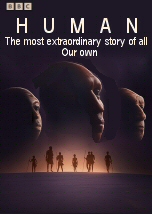
Spanning five gripping episodes presented together in one seamless video, this sweeping journey explores 300,000 years of human evolution, revealing groundbreaking discoveries that are reshaping everything we thought we knew about our origins. From the first appearance of Homo sapiens in Africa—at a time when at least six other human species walked the Earth—to the dramatic encounters with Neanderthals and the mysteries of their disappearance, each chapter uncovers the epic struggle for survival and dominance. As the Ice Age grips the planet, humanity pushes into the Americas, braving the harshest conditions in history. Finally, as the ice recedes, a transformation begins: the shift from wandering hunters to the builders of the first permanent settlements. This story brings to life the triumphs, dangers, and defining moments that made us who we are today.
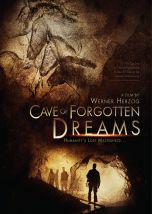
A documentary by Werner Herzog, who gained exclusive access to film inside the Chauvet caves of Southern France and captures the oldest known pictorial creations of humanity. Some of them were crafted as much as 32,000 years ago. The film consists of images from inside the cave as well as of interviews with various scientists and historians. Also includes footage of the nearby Pont d'Arc natural bridge.






















Thanks to state-of-the-art ultra-photorealistic imagery in 3D or 2D, see science come alive in a unique and entertaining manner. Immerse yourself in a lost age, 200 million years back in time, and get ready for a face-to-face encounter with the T-Rex of the seas. Directed by Ronan Chapalain and Pascal Vuong.