





In these three episodes, we see how Japan’s war in China, U.S. sanctions, and the desperate search for vital resources push the Pacific toward a decisive breaking point. Driven by military ambition and imperial ideology, Japan launches the attack on Pearl Harbor, shocking the world and bringing America fully into World War II. From that moment, the conflict becomes a vast struggle across oceans, supply lines, naval codes, aircraft carriers, submarines, and nations fighting for survival. The story then moves into the brutal battle for control of the seas, where German U-boats threaten Britain’s lifeline in the Atlantic while Japan’s powerful navy tries to dominate the Pacific. After Pearl Harbor, Japanese forces sweep through Southeast Asia with alarming speed, but on Guadalcanal their advance meets fierce resistance. In the jungle, at sea, and in the air, U.S. Marines face exhaustion, fear, and relentless combat in one of the first great tests of America’s resolve in the Pacific.
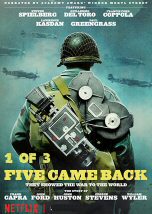
The wartime contributions of five prominent Hollywood film directors during World War II are profiled. The documentary focuses on five directors – John Ford, William Wyler, John Huston, Frank Capra, and George Stevens – whose war-related works are analysed by modern filmmakers, respectively Paul Greengrass, Steven Spielberg, Francis Ford Coppola, Guillermo del Toro, and Lawrence Kasdan. In the first episode, John Ford's The Battle of Midway was approved directly by President Franklin D. Roosevelt while Frank Capra fights to get Why We Fight made.
This series, narrated and written by Oliver Stone and co-author Peter Kuznick, will focus on human events that at the time went under reported, but crucially shaped America’s unique and complex history over the 20th and 21st century. The series is a re-examination of some of the under-reported and darkest parts of American modern history using little known documents and newly uncovered archival material. The series looks beyond official versions of events to the deeper causes and implications and explores how events from the past still have resonant themes for the present day." The fist episode examines World War II. It offers special attention to the Spanish Civil War, Roosevelt's desire to enter the war on the side of the allies, the strategic Japanese decisions that lead up to Pearl Harbor Attack, and the often overlooked role that the Soviet Union had in winning the war.
This episode examines the end of and the period immediately after World War II. It looks at Stalin's efforts to seize control of Poland and Eastern Europe, Democratic part bosses efforts to drop Henry Wallace from the 1944 presidential ticket, and British efforts to maintain their colonial holdings after the war.
Rockefeller, Carnegie and Morgan team up to help elect William McKinley to the U.S. presidency by paying for his 1896 campaign, to avoid a possible attack on monopolies. However, fate intervenes when McKinley is suddenly assassinated, and vice president Theodore Roosevelt assumes the presidency and promptly begins dissolving monopolies and trusts in America. Meanwhile, Morgan buys out Carnegie Steel to make Carnegie the richest man in the world, and Henry Ford designs an affordable automobile with his Model T and starts his own business, Ford Motor Company, which sets a new business model for companies to follow.
When Japan’s military expansion in the Pacific reaches its fever pitch, Roosevelt is forced to act. By cutting off oil supplies, he hopes to force Japan to back down. But far from sedating their imperial expansions, he pushes them to take one of the greatest gambles in military history – taking their entire striking fleet 4000 miles across the Ocean to attack the American Pacific fleet in Pearl Harbor. It’s a huge gamble, and if it goes wrong, it will spell suicide for Japan.
The story then moves into the brutal battle for control of the seas, where German U-boats threaten Britain’s lifeline in the Atlantic while Japan’s powerful navy tries to dominate the Pacific. After Pearl Harbor, Japanese forces sweep through Southeast Asia with alarming speed, but on Guadalcanal their advance meets fierce resistance. In the jungle, at sea, and in the air, U.S. Marines face exhaustion, fear, and relentless combat in one of the first great tests of America’s resolve in the Pacific.