A deep sea diver is stranded on the seabed with 5 minutes of oxygen and no hope of rescue. With access to amazing archive this is the story of one man's impossible fight for survival. Chris Lemons were carrying out repairs 100m below the surface of the North Sea, supported by the vessel Bibby Topaz. The vessel's dynamic positioning system failed, causing it to snap the umbilical tether that provided Lemons oxygen, as well as hot water to heat his suit, power for his light, and a radio link to the surface. He was left with only the few minutes of breathable gas contained in the cylinders he wore on his back. For reasons that are unclear, Lemons survived for around 30 minutes while he was located by a remote underwater vehicle and then by Yuasa, who was able to pull him back onboard the diving bell. The documentary uses genuine footage and audio recorded at the time of the accident on the divers' radios and body cameras, supplemented with interviews of several of the individuals involved, as well as some reconstructed footage, to tell the story of the accident.
Almost everything we know today about the beautiful giant ringed planet comes from Cassini, the NASA mission that launched in 1997 and arrived at Saturn in 2004. Since then, the space probe has been beaming home miraculous images and scientific data, revealing countless wonders about the planet, its rings and 62 moons - including some that could harbor life. When the mission approached its final days, it attempted one last set of daring maneuvers - diving between the innermost ring and the top of Saturn's atmosphere. Aiming to skim less than 2000 miles above the cloud tops, no spacecraft has ever gone so close to Saturn, and hopes were high for incredible observations that could solve major mysteries about the planet's core. But such a daring maneuver comes with many risks and is no slam dunk. In fact, slamming into rocks in the rings is a real possibility. Join NASA engineers for the tense and triumphant moments as they find out if their bold re-programming has worked, and discover the wonders that Cassini has revealed over the years.
In the shady camp grounds of Yosemite valley, climbers carved out a counterculture lifestyle of dumpster-diving and wild parties that clashed with the conservative values of the National Park Service. And up on the walls, generation after generation has pushed the limits of climbing, vying amongst each other for supremacy on Yosemite's cliffs. 'Valley Uprising' is the riveting, unforgettable tale of this bold rock climbing tradition in Yosemite National Park: half a century of struggle against the laws of gravity - and the laws of the land.
Located beneath Russia's Ural Mountains, Orda Cave is legendary among divers for its unique beauty. The cave's waters are clearest in winter, when the land above lies frozen. With temperatures approaching minus 40 degrees, NHK attempts to film the cave for the first time ever using 4K cameras. Scientists give them insight into the cave's origins, enabling the crew to uncover the miraculous story of how the cave was naturally formed 300 million years ago by climate change and a shifting landscape.
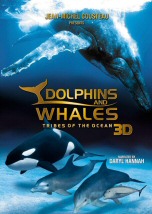
This awe-inspiring documentary film narrated by Daryl Hannah will take you from the dazzling coral reefs of the Bahamas to the warm depths of the waters of the exotic Kingdom of Tonga for a close encounter with the surviving tribes of the ocean. Through the powerful IMAX 3D theatre medium and stunning images, view their lives and habitats as never-before-seen. You will come so close to wild dolphins and belugas you will virtually touch them. You will witness the profound love of a Humpback mother for her newborn calf, and will come eye-to-eye with singing Humpback males. You will meet an orca, the mighty King of the ocean, and enjoy a wonderful moment with the gentle manatee. Explore many little-known aspects of these fascinating and fragile creatures capable of sophisticated communication and social interaction. Join this expert team of ocean explorers in an unforgettable diving experience that documents the life of these graceful, majestic yet endangered sea creatures.
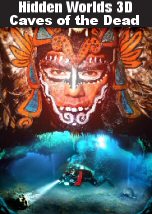
In the days of the Mayas, cenotes – deep, natural pits on the Yucatan peninsula - provided the only means of obtaining drinking water. But in the mythology of this advanced civilisation, these waterholes and caves were also the entrance to Xibalba – the underworld. All deceased were obliged to pass through Xibalba and wait there until they were called into heaven. It was a place in which one made sacrifices to the gods – objects of daily life, as well as bloody, human sacrifices. To this day, the relics of these acts are still in place preserved underwater for more than a thousand years. The entrance to the underworld begins at a dirty waterhole in the middle of the Mexican jungle overgrown and barely recognisable. But immediately after entry, a hall of breath-taking dimensions and beauty is revealed. As if they were sculptures, stalactites and stalagmites lend the underwater cave an almost sacred ambience. By now, one has succumbed to the fascination emanated by the world’s largest underwater cave system. We accompany four professional research divers to Yucatan – a team of specialists, able to squeeze their bodies through crevices and holes, barely larger than their bodies and who master dives that would push even the most experienced divers to their limits. With them, we penetrate worlds only a few people have ever ventured into. We encounter the remains of human victims, prehistoric fireplaces and primeval animal skeletons and undertake a dive, which takes us from the primeval forest to the open sea. We then enter Xibalba – the place of myths and the dead. In the days of the Mayas - a voyage of no return. Today, this is one of the greatest challenges one can face as a diver – the hidden world of the underwater caves of Yucatan – all filmed in 3D.



















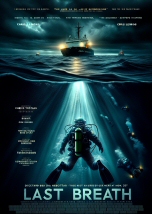




Chris Lemons were carrying out repairs 100m below the surface of the North Sea, supported by the vessel Bibby Topaz. The vessel's dynamic positioning system failed, causing it to snap the umbilical tether that provided Lemons oxygen, as well as hot water to heat his suit, power for his light, and a radio link to the surface. He was left with only the few minutes of breathable gas contained in the cylinders he wore on his back.
For reasons that are unclear, Lemons survived for around 30 minutes while he was located by a remote underwater vehicle and then by Yuasa, who was able to pull him back onboard the diving bell. The documentary uses genuine footage and audio recorded at the time of the accident on the divers' radios and body cameras, supplemented with interviews of several of the individuals involved, as well as some reconstructed footage, to tell the story of the accident.