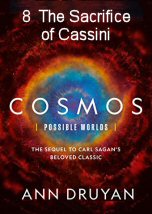
The 8th episode reviews Giovanni Cassini's life. His observations of Saturn and its moons would have an enduring effect on the scientific world. Neil deGrasse Tyson also narrates the mysterious untold story of the scientist who figured out how to go the Moon while fighting for his life in a WWI trench. Aleksandr Shargei changed his name to Yuri Kondratyuk out of fear for his life and wrote a manuscript on rocket motion and space colonization. This letter would end up capturing the attention of an engineer working on the Apollo program, John Houbolt, and would made the Apollo Mission possible. We will also know the saga of the twenty-year long odyssey of Cassini-Huygens spacecraft, a robotic explorer ordered to commit suicide on another world.
This remarkable science-history series investigates the blistering pace of human endeavour in space exploration, computing, energy, resources, Earth science and our understanding of the evolution of life itself. Across the last 50 years, humans have set a blistering pace and scientific discovery. We've crossed the boundaries of our solar system, made machines that can learn harnessed the power of the sun and built life from scratch. It's a period like no other in history, where human endeavour is changing everything: this is The Great Acceleration. As we race toward the future, we must examine the journey. In the first episode, Dr Shalin Naik explores the ambitious space shuttle mission that began in the '70s plus the future colonization of Mars. Over the past 50 years, space has become central to everything, from communications to entertainment to climate modelling. And as private enterprise enters space exploration, our understanding of the universe will only continue to expand. We will know if we can survive on other objects - the moon, maybe Mars, maybe even some of the moons of Jupiter and Saturn. Deep space is the last and infinite frontier. That's what we do as human beings. We explore, we learn, we make discoveries, from the moment we're born to the moment we die.
The Blue Marble is an image of Earth taken on 1972, from a distance of about 18,000 miles from the planet's surface. It was taken by the crew of the Apollo 17 spacecraft on its way to the Moon. Before it was photographed from space, our perspective of Earth was fragmented and disconnected. Recent discoveries have revealed a dynamic and rapidly changing planet, above the crust and below.
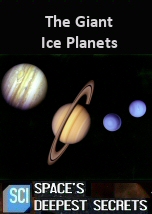
Uranus and Neptune, two of the largest, farthest and strangest planets in our solar system. These two planets break all the rules. Of all the big planets, Uranus and Neptune remain the biggest enigmas. Today, astronomers are finally unlocking why these supersized snowballs are so weird. Can an ancient mega-collision reveal what knocked Uranus onto its side? Can a missing twin world unlock why one of Neptune's moons orbits the wrong way? And what is the energy that drives the fastest winds in the solar system?
The jeweled-encrusted pectoral of King Tut is a hieroglyphic artefact of stunning craftsmanship and one of the greatest treasures of the pharaohs. Was this ancient glass scarab in Tutankhamun's tomb created by forces from beyond our world? Using new research and the latest tech, experts confront the ancient mystery of its flawless glass scarab. Is a 4,000 year old clay tablet the original instruction manual for Noah's ark? And how can a bizarre red moon rock contain signs of life?
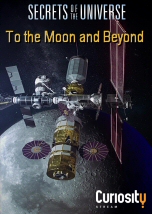
We’re going back to the moon. Plans are being made, hardware is being designed, built, and tested to return humans to the moon and beyond in a new era of American space exploration. This episode explores how we did it in the past, and how and why we will do it again. The moon is critical to future explorations: it will be where we learn to build sustainable colonies on other worlds.






















We will also know the saga of the twenty-year long odyssey of Cassini-Huygens spacecraft, a robotic explorer ordered to commit suicide on another world.