The great flood in the Okavango turns 4,000 square miles of arid plains into a beautiful wetland. Elephant mothers guide their families on an epic trek across the harsh Kalahari Desert towards it, siphoning fresh water from stagnant pools and facing hungry lions. Hippos battle for territory, as the magical water draws in thousands of buffalo and birds, and vast clouds of dragonflies. Will the young elephant calves survive to reach this grassland paradise? The experienced mother elephants time their arrival at the delta to coincide with the lush grass produced by the great flood. In a TV first, the programme shows the way they use their trunks to siphon clean water from the surface layers of a stagnant pool, while avoiding stirring up the muddy sediment on the bottom with their feet. Lechwe swamp deer, zebras, giraffes, crocodiles and numerous fish and thousands of birds arrive in the delta. And, in a phenomenon never before filmed in the Okavango, thousands of dragonflies appear - seemingly from nowhere - within minutes of the flood arrival, mating and laying eggs. As the flood finally reaches its peak, elephants and buffalo, near the end of their epic trek across the desert, face the final gauntlet of a hungry pride of lions. In a heart-wrenching sequence, a baby elephant is brought down by a lion in broad daylight.
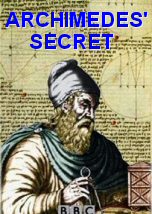
This is the story of a book that could have changed the history of the World. To the untrained eye, it is nothing more than a small and unassuming Byzantine prayer book. For faintly visible beneath the prayers on its pages are other, unique, writings - words that have been lost for nearly two thousand years. The text is the only record of work by one of the world's greatest minds - the ancient Greek, Archimedes - a mathematical genius centuries ahead of his time. Hidden for a millennium in a middle eastern library, it has been written over, broken up, painted on, cut up and re-glued. But in the nick of time scientists have saved the precious, fragile document, and for the first time it is revealing just how revolutionary Archimedes' ideas were. If it had been available to scholars during the Renaissance, we might have reached the Moon over a hundred years ago.
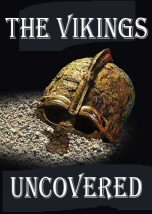
Dan Snow uncovers the lost Vikings in America with space archaeologist Dr Sarah Parcak. Sarah uses satellites 383 miles above the earth to spot ruins as small as 30cm buried beneath the surface. As Sarah searches for Viking sites from Britain to America, Dan explores how they voyaged thousands of miles when most ships never left the shoreline. He also tracks their expansion west, first as raiders and then as settlers and traders throughout Britain and beyond to Iceland and Greenland. In North America they excavate what could be the most westerly Viking settlement ever discovered.
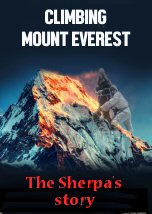
Every year, over a thousand climbers try to reach the summit of Mount Everest, with the annual record for successful attempts currently standing at 633. But of that number, nearly half were Sherpas - the mountain's unsung heroes. Yet the Sherpa community has remained secretive about their nation, culture and experiences living in the shadow of the world's highest mountain. Now, for the first time, they open the door into their world. Without the expertise of the Sherpas, only the hardiest and most skilful climbers would succeed. Every day they risk their lives for the safety of others, yet they seek neither glory nor reward, preferring to stay in the background. Following the stories of four such Sherpas - Phurba, Ngima, Ngima Tenji and Gelu - this film reveals the reality of their daily lives, not just up the mountain, but with their families after they return home.
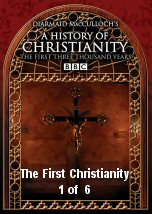
Professor Diarmaid MacCulloch - one of the world's leading historians - reveals the origins of Christianity and explores what it means to be a Christian. In the first episode, he overturns the familiar story that it all began when the apostle Paul took Christianity from Jerusalem to Rome. Instead, he shows that the true origins of Christianity lie further east, and that at one point it was poised to triumph in Asia, maybe even in China. The headquarters of Christianity might well have been Baghdad not Rome, and if that had happened then Western Christianity would have been very different.
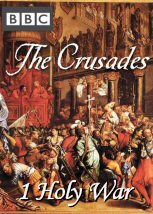
Dr. Thomas Asbridge introduces the epic story of the Crusades – a tale of religious fanaticism and unspeakable brutality, of medieval knights and Jihadi warriors; of castles and kings; of heroism, betrayal, and sacrifice. He explains how, using fresh evidence, eye-witness testimonies and contemporary accounts – from both the Christian and Islamic worlds – we are able to re-examine this epic medieval drama, and how he has retraced the steps of the Crusaders from a small town in France to the magnificent cities of the Holy Land, bringing to life the human experience of the Crusades, and shedding new light on how it was that two of the world’s great religions waged war in the name of God.









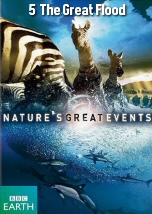


In a TV first, the programme shows the way they use their trunks to siphon clean water from the surface layers of a stagnant pool, while avoiding stirring up the muddy sediment on the bottom with their feet. Lechwe swamp deer, zebras, giraffes, crocodiles and numerous fish and thousands of birds arrive in the delta. And, in a phenomenon never before filmed in the Okavango, thousands of dragonflies appear - seemingly from nowhere - within minutes of the flood arrival, mating and laying eggs. As the flood finally reaches its peak, elephants and buffalo, near the end of their epic trek across the desert, face the final gauntlet of a hungry pride of lions. In a heart-wrenching sequence, a baby elephant is brought down by a lion in broad daylight.