







Last Watched

"Physics"  Sort by

Strangest Things

   2008    Science
From stars, galaxies and moons to subatomic particles, black holes and invisible phenomena, discover the most bizarre, mysterious and exotic things in our universe
Series: The Universe
Messengers

   2011    Science
Professor Brian Cox travels from the fossils of the Burgess Shale to the sands of the oldest desert in the world to show how light holds the key to our understanding of the whole universe, including our own deepest origins. To understand how light holds the key to the story of the universe; you first have to understand its peculiar properties. Brian considers how the properties of light that lend colour to desert sands and the spectrum of a rainbow can lead to profound insights into the history and evolution of our universe. Finally, with some of the world's most fascinating fossils in hand, Brian considers how but for an apparently obscure moment in the early evolutionary history of life, all the secrets of light may have remained hidden. Because although the universe is bathed in light that carries extraordinary amounts of information about where we come from, it would have remained invisible without a crucial evolutionary development that allowed us to see. Only because of that development can we now observe, capture and contemplate the incredible wonders of the universe that we inhabit.
Series: Wonders of the Universe

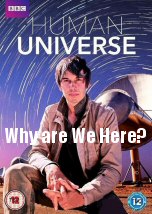
Why are We Here

   2014    Science
In episode two, Professor Brian Cox is off to India, where he assesses arguably the first evidence of rational thought in literature, the poetry of the Vedic monks. They pondered mankind's origins, realising there must have been a day with no yesterday - a day of creation - prompting the age-old question of where did the universe come from? Brian marvels that the universe seems to follow a set of rules, the laws of physics, allowing space to be considered on the grandest scale, travelling to the most distant, farthest reaches of the cosmos just by using our minds. Brian also visits Japan, and offers viewers the idea that man lives in just one of an infinite number of universes that are being made all the time.
Series: Human Universe

The End of the Universe

   2014    Science
How and when will the Universe end? Gravity and dark matter are poised to annihilate the Universe in a big crunch. Expansion and dark energy may tear it apart. Or, a phase transition could kill us tomorrow in a cosmic death bubble.
Series: How the Universe Works

Colours Of Earth

   2015    Science
In this episode, Helen seeks out the colours that turned planet Earth multicoloured. To investigate the essence of sunlight Helen travels to California to visit the largest solar telescope in the world. She discovers how the most vivid blue is formed from sulfur atoms deep within the Earth's crust and why the presence of red ochre is a key sign of life. In gold, she discovers why this most precious of metals shouldn't even exist on the surface of the planet and in white, Helen travels to one of the hottest places on Earth to explore the role salt and water played in shaping planet Earth.
Series: Colour The Spectrum of Science

Stephen Hawking on Black Holes

   2016    Science
The film looks at the latest understanding of black holes, featuring an interview with Stephen Hawking. Black holes are one of the greatest mysteries in the universe. They behave in a way that is contrary to laws of physics and one has never actually been seen. However, the recent detection of gravitational waves, as predicted by Einstein, proves that black holes exist and provides a way to investigate their remarkable behaviour and properties.
Series: The Sky at Night