Water plants create some of the most beautiful, bizarre and important habitats on earth. To hold on in torrents, plants use a kind of superglue. Some are armed with vicious weapons to fight titanic battles for space. Others form perfect spheres and escape from animal enemies by rolling. Where nutrients are washed away, plants turn into hunters of animals, laying traps and even counting to ensure their success. In this episode we explore those watery worlds with David Attenborough, from Croatia to Brazil, from Colombia to Thailand, the brilliantly coloured flowers smother lakes, and in one magical river in Brazil, the water bubbles like champagne as plants create the atmosphere itself.
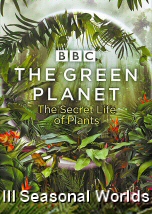
Will explore the strategy, deception and feats of engineering plants use to thrive in the changing weather of different seasons. In the face of conditions ranging from ice and snow to raging fires, survival is often a question of perfect timing - particularly when contending with intense competition and surprising predators. In this episode, David Attenborough travels to Finland to show one of the most extreme examples of seasonal plant life in the Arctic Circle. He also travels to California to see how climate change is affecting giant sequoias. These ancient trees like all other seasonal plants depend on the predictability of the seasons and our current changing climate threatens their survival.
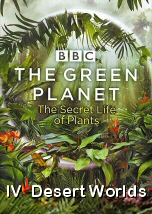
Plants that have developed to thrive in the desert, including cacti that grow in the shade of other trees and collect water in pleated trunks that expand and contract - but can also find themselves a host to other plants, like desert mistletoe. This programme also reveals how tobacco plants being eaten by caterpillars are able to summon the creatures' natural predators, and how tumbleweeds roll across the landscape, only unfurling and growing when they encounter rain.
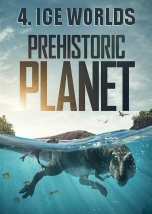
In the fourth episode, Dromaeosaurs stalk a hadrosaur herd as they cross a freezing river. Male Ornithomimus raid rival nests to bolster their own. Olorotitan raise their offspring on fertile volcanic fields but contend with biting mosquitoes. Troodontids hunt mammals flushed out by a forest fire. A juvenile Antarctopelta scours the forest for a new winter den. Within the snow-covered forest, a tense standoff develops between ancient rivals, Pachyrhinosaurus and Nanuqsaurus.
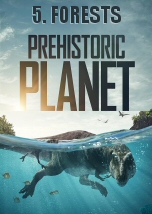
In the last episode, Austroposeidon level trees in search of fresh foliage. A herd of Triceratops journey through a cave to find an underground clay lick. A male Carnotaurus sets the stage for an extravagant display. A female Qianzhousaurus uses an autumn storm to her advantage while hunting Corythoraptor. A family of Edmontosaurus evade a forest fire, while an Atrociraptor and Ankylosaur reap its rewards. Juvenile Therizinosaurus attempt to climb up to a bee nest. Hatzegopteryx hunts Zalmoxes, and patrols the dense undergrowth and seaspray-battered coastline.
In this mind-bending series, Professor Jim Al-Khalili explores the vast range of size in the universe, from tiny atoms to gigantic, interconnected galaxies. In the first episode, Jim will enter the world of objects that are too tiny to glimpse with the naked eye. Starting with the smallest insects, he moves on to encounter living cells with amazing superpowers and confronts some of humanity's deadliest enemies in the form of viruses. Going smaller still, he encounters wondrous new nanomaterials such as graphene, discovered by physicist Andre Geim. These are revolutionising engineering, medicine, computing, electronics and environmental science. Finally, Jim comes face to face with the fundamental building blocks of the world around us – atoms – and reveals why understanding the science of the 'small' is crucial to the future of humanity.
















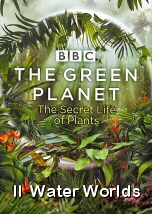






In this episode we explore those watery worlds with David Attenborough, from Croatia to Brazil, from Colombia to Thailand, the brilliantly coloured flowers smother lakes, and in one magical river in Brazil, the water bubbles like champagne as plants create the atmosphere itself.