






Last Watched

"Eve"  Sort by

Unafraid of the Dark

   2014    Science
Tyson describes the discovery of cosmic rays by Victor Hess through high-altitude balloon trips. Swiss Astronomer Fritz Zwicky, in studying supernovae, postulated that these cosmic rays originated from these events instead of electromagnetic radiation. Also tells how Vera Rubin observed that the rotation of stars at the edges of observable galaxies did not follow expected rotational behavior leading to consider the existence of dark matter. This further led to the discovery of dark energy to account for the increasing rate of expansion of the universe. Tyson then describes the interstellar travel of the two Voyager probes. Tyson tells the Carl Sagan's role in the Voyager program, including creating the Voyager Golden Record to encapsulate humanity and Earth's position in the universe. Tyson concludes the series by emphasizing Sagan's message on the human condition in the vastness of the cosmos, and to encourage viewers to continue to explore and discover what else the universe has to offer.
Series: Cosmos: A Spacetime Odyssey

Easy Listening

   2013    Art
Series concludes with the focus shifting to the United States in the post-war years of the 1950s and beyond. Beginning with arguably the most notorious work of 20th century classical music, John Cage's 'silent' composition 4'33", it looks at how a series of maverick Americans re-invented the sound of classical music into a more simple form, bringing back harmonies and rhythms that made it increasingly popular with audiences across the world. It also examines how this music found its way into a spiritual realm, with the strain of pared-down religious composition that came to be known as 'holy minimalism'. From the Maverick concert hall in Woodstock, New York to an Orthodox cathedral in Estonia to a car park in Peckham, south London, the story is told by a stellar line-up of contributors including Philip Glass, Steve Reich, John Adams, Arvo Pärt and John Tavener.
Series: The Sound and the Fury

Falling

   2011    Science
Professor Brian Cox takes on the story of the force that sculpts the entire universe - gravity. Gravity seems so familiar, and yet it is one of the strangest and most surprising forces in the universe. Starting with a zero gravity flight, Brian experiences the feeling of total weightlessness, and considers how much of an effect gravity has had on the world around us. But gravity also acts over much greater distances. It is the great orchestrator of the cosmos. It dictates our orbit around the sun, our relationship with the other planets in our solar system, and even the way in which our solar system orbits our galaxy. Yet the paradox of gravity is that it is actually a relatively weak force. Brian takes a face distorting trip in a centrifuge to explain how it is that gravity achieves its great power, before looking at the role it plays in one of the most extraordinary phenomena in the universe - a neutron star. Although it is just a few kilometres across, it is so dense that its gravity is 100, 000 million times as strong as on Earth. Over the centuries our quest to understand gravity has allowed us to understand some of the true wonders of the universe, and Brian reveals that it is scientists' continuing search for answers that inspires his own sense of wonder.
Series: Wonders of the Universe

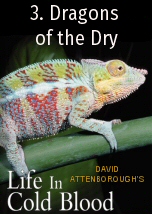
Dragons of the Dry

   2008    Nature
About 340 million years ago a brand new family of animals was evolving in the primeval swamps. They were to go one step further than the amphibians who had emerged onto dry and before them. For they would eventually completely cut their ties with water. They were the ancestors of todays lizards. They evolved scaly impermeable skins and moved up into the forests. They diversified into a multitude of different shapes and sizes. They developed signalling systems to communicate with one another. And they squabbled as animals do. For food they hunted insects that were already well established on the land in great numbers. And here without returning to water they produced their families. They powered their bodies not only with food but with the heat that they drew directly from the sun.
As they diversified so they spread into the harshest of the lands habitats. The baking waterless deserts which eventually they would come to dominate. Discover jacky lizards that wave, wrestling beaded lizards and the the world's smallest chameleon, which is no bigger than his thumbnail, and the biggest lizard in Australia.
Series: Life In Cold Blood

Frozen Planet: Summer

   2011    Nature
It is high summer in the Polar Regions, and the sun never sets. Vast hordes of summer visitors cram a lifetime of drama into one long, magical day; they must feed, fight and rear their young in this brief window of plenty. Summer is a tough time for the polar bear family, as their ice world melts away and the cubs take their first swimming lesson. Some bears save energy by dozing on icy sun beds, while others go egg-collecting in an Arctic tern colony, braving bombardment by sharp beaks. There are even bigger battles on the tundra; a herd of musk oxen gallop to the rescue as a calf is caught in a life and death struggle with a pair of Arctic wolves. But summer also brings surprises, as a huge colony of 400,000 king penguins cope with an unlikely problem - heat. The adults go surfing, while the woolly-coated chicks take a cooling mud bath. Nearby, a bull fur seal is prepared to fight to the death with a rival. Fur flies as the little pups struggle desperately to keep out of the way of the duelling giants. Further south, a minke whale is hunted amongst the ice floes by a family of killer whales. The dramatic chase lasts over 2 hours and has never been filmed before. The killers harry the minke whale, taking it in turns to wear it down. Eventually it succumbs to the relentless battering. Finally, comical adelie penguins waddle back to their half a million strong colony like clockwork toys. The fluffy chicks need constant feeding and protection as piratical skuas patrol the skies. When an unguarded chick is snatched, a dramatic "dogfight" ensues.
Series: Frozen Planet

Frozen Planet: Autumn

   2011    Nature
For the animals in the polar regions, autumn means dramatic battles and epic journeys. Time is running out - the Arctic Ocean is freezing over and the sea ice is advancing at 2.5 miles per day around Antarctica. Polar bears gather in large numbers on the Arctic coast as they wait for the return of the ice. Soon, tempers fray and violent sparring contests break out. Meanwhile 2,000 beluga whales head for one special estuary, a gigantic 'whale spa' where they will thrash their snow-white bodies against the gravel and exfoliate. Inland, the tundra undergoes a dramatic transformation from green to fiery red. Here, musk ox males slam head-first into each other with the force of a 30mph car crash as they struggle to defend their harems. Frisky young caribou males play a game of 'grandma's footsteps' as they try to steal the boss's female. Down in Antarctica, Adelie penguin chicks huddle together in creches. When a parent returns from fishing, it leads its twins on a comical steeplechase - sadly there's only enough for one, so the winner gets the meal. Two months later and the chicks are fully feathered apart from downy Mohican hairdos - they're ready to take their first swim - reluctantly though, as it seems penguins are not born with a love of water! And with good reason - a leopard seal explodes from the sea and pulls one from an ice floe, a hunting manoeuvre that has never been filmed before. As winter approaches and everyone has left, the giant emperor penguin arrives and makes an epic trek inland to breed. The mothers soon return to the sea leaving the fathers to hold the eggs and endure the coldest winter on earth.
Series: Frozen Planet
Leaving Neverland

Leaving Neverland

2019  Culture
Life

Life

2009  Nature
The Art of Germany

The Art of Germany

2010  Art
Top Gear

Top Gear

2012  Technology
Cooked

Cooked

2016  Culture
Food Inc

Food Inc

2009  Technology