

Last Watched

"Ancient"  Sort by

Behind Closed Doors

   2012    History
In this final episode, Mary Beard delves even deeper into ordinary Roman life by going behind the closed doors of their homes. She meets an extraordinary cast of characters - drunken housewives, teenage brides, bullied children and runaway slaves - and paints a more dynamic, lusty picture of Roman family life. Mary uncovers their preserved beds, furniture and cradles, tries on Roman wedding rings and meets some eccentric wives like Glyconis, praised by her husband for liking a drink or two, and Allia Potestas, who lived in a Roman menage a trois. Mary explores Roman parenting, childbirth and children, including Sulpicius Maximus, an 11-year-old schoolboy who was worked to death by his pushy parents, and Geminia Mater, a 5-year-old tomboy. Finally, Mary paints a more nuanced picture of Roman slavery and asks why if it was such a brutal institution did many Romans choose to be buried with their servants - living cheek by jowl in death, as in life
Series: Meet the Romans
Kingdom of the Desert

   2013    History
In the spectacular deserts of coastal Peru, archaeologist Dr Jago Cooper explores the dramatic rise and fall of Chimor, the first empire of South America. His journey begins among the ruins of a vast lost city once home to an all-powerful monarchy, whose subjects transformed the desert landscape, created gold and silver treasures and believed so strongly in the power of their gods that they made the most shocking of sacrifices. Chimor thrived despite facing some of the most extreme climate conditions in the world, but not even this powerful empire could withstand the forces that eventually destroyed it.
Series: Lost Kingdoms of South America

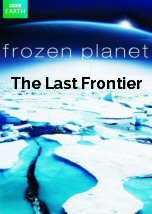
Frozen Planet: The Last Frontier

   2011    Culture
The documentary series reveals the extraordinary riches and wonders of the Polar Regions that have kept people visiting them for thousands of years. Today, their survival relies on a combination of ancient wisdom and cutting-edge science. Most Arctic people live in Siberia, either in cities like Norilsk - the coldest city on earth - or out on the tundra, where tribes like the Dogan survive by herding reindeer, using them to drag their homes behind them. On the coast, traditional people still hunt walrus from open boats - it is dangerous work, but one big walrus will feed a family for weeks. Settlers are drawn to the Arctic by its abundant minerals; the Danish Armed Forces maintain their claim to Greenland's mineral wealth with an epic dog sled patrol, covering 2,000 miles through the winter. Above, the spectacular northern lights can disrupt power supplies so scientists monitor it constantly, firing rockets into it to release a cloud of glowing smoke 100 kilometres high. In contrast, Antarctica is so remote and cold that it was only a century ago that the first people explored the continent. Captain Scott's hut still stands as a memorial to these men. Science is now the only significant human activity allowed; robot submarines are sent deep beneath the ice in search of new life-forms, which may also be found in a labyrinth of ice caves high up on an active volcano. Above, colossal balloons are launched into the purest air on earth to detect cosmic rays. At the South Pole there is a research base designed to withstand the world's most extreme winters. Cut off from the outside world for six months, the base is totally self-sufficient, even boasting a greenhouse.
Series: Frozen Planet

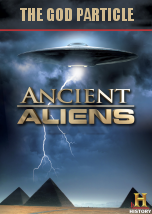
The God Particle

   2014    Culture
Researchers discuss the possibility that the creation of the Large Hadron Collider was foretold in ancient sources that were inspired by aliens
Series: Ancient Aliens

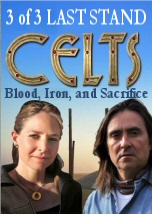
Last Stand

   2015    History
The Roman army turns its attention to an island of rich resources, powerful tribes and druids, and advanced military equipment - Britain. This episode tells the story of the Celts' last stand against the Roman army - a revolt led by another great leader, the warrior queen Boudicca.
Series: The Celts: Blood, Iron, and Sacrifice

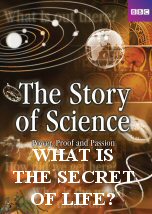
What is the Secret of Life

   2010    Science
The story of how the secret of life has been examined through the prism of the most complex organism known - the human body. It begins with attempts to save the lives of gladiators in Ancient Rome, unfolds with the macabre work and near-perfect drawings of Leonardo in the Renaissance, through the idea of the 'life force' of electricity, to the microscopic world of the cell. It reveals how a moral crisis unleashed by work on the nuclear bomb helped trigger a great breakthrough in biology - understanding the structure and workings of DNA.
Series: The Story of Science
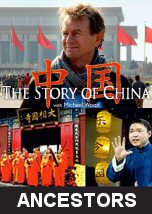
The Story of China

The Story of China

2016  History
Space

Space

2001  Science
Tiger

Tiger

2020  History
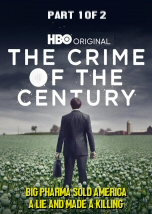
The Crime of the Century

The Crime of the Century

2021  Medicine
Racism: A History

Racism: A History

2007  Culture
The Great Acceleration

The Great Acceleration

2020  Technology
Leaving Neverland

Leaving Neverland

2019  Culture