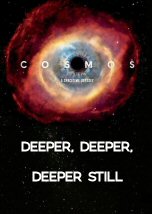
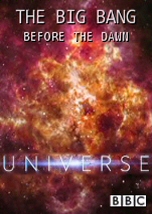
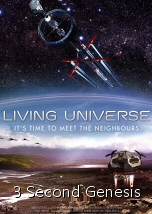
How did the universe come to be? Thanks to a series of discoveries, our most powerful space missions have unravelled 13.8 billion years of cosmic evolution and revealed the story of our universe from its birth all the way to the arrival of our nascent civilization. Our guide on this odyssey back to the dawn of time is light. Telescopes are time machines - by looking out into the distant universe, they open a window to the past. One telescope more than any other has helped us journey through the history of the universe: NASA’s Hubble Space Telescope. Remarkably, Hubble has even found one of the first galaxies ever to exist in the universe, which was born some 13.4 billion years ago. It's a discovery that hints at the beginnings of our own Milky Way. Vivid CGI brings this ancient galaxy to life, allowing us to witness for ourselves the first dawn. It was the beginning of a relationship between stars and planets that would, on a faraway world, lead to the origin of life - and ultimately to us. Hubble’s incredible discoveries have allowed scientists to piece together much of our cosmic story, but it cannot take us back to the most important moment in history: the Big Bang. For decades, the moment the universe began was the subject of pure speculation, but by combining astronomy and cosmology, scientists have finally found a way to put their theories to the test and study the momentous events that took place during the Big Bang. They can do this because the European Space Agency’s Planck space telescope has seen the afterglow of the Big Bang itself – something we call the Cosmic Microwave Background. The unparalleled detail Planck gave us has helped confirm something remarkable: the Big Bang may not be the beginning. There was a time before the dawn – a place beyond anything we can comprehend. Professor Brian Cox transports us back to the fraction of a second before the Big Bang, when the seeds of our universe were planted.
The film is an immersive chronicle of the insurrection at the U.S. Capitol on January 6, 2021, when thousands of Donald Trump's followers from across the country gathered in Washington D.C. to protest the results of the 2020 presidential election, many with the intent of disrupting the certification of Joe Biden’s presidency. 'Four Hours at the Capitol' features never-before-seen footage and vivid first-hand accounts from lawmakers, staffers, police officers, protesters, and rioters who stormed the Capitol building where the electoral votes were being counted. The film details how the violence quickly escalated, leaving Capitol security forces outnumbered and overwhelmed, and highlights the high-stakes standoff between police and rioters. The documentary presents a stark reminder of the wider ramifications of the events of that unprecedented day, which ended with the deaths of five people and more than 140 police officers injured.
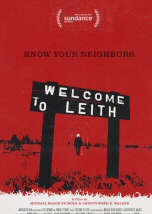
When notorious white supremacist Craig Cobb moves into their town, the residents of Leith in North Dakota do what they can to prevent him from taking control of the municipality. Filmed in the days leading up to Cobb's arrest for terrorizing the townspeople on an armed patrol and his subsequent release from jail six months later, the film is an eerie document of American DIY ideals.
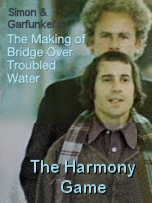
The end of a decade when the world was in crisis and inspiration and hope needed resurrecting, an influential duo released a masterpiece of popular music, Bridge Over Troubled Water. Through darkness and light, the album takes its listeners on an emotional ride echoing the era and one which continues to inspire an audience the world over 50 years later. Its symphonic hymn of a title track became an anthem for a generation. The Harmony Game tells the story behind what is widely considered Simon and Garfunkel's best work, Bridge Over Troubled Water. The influential duo's last studio album has its legacy shrouded in rock n' roll mythology with legendary tales of inspiration, innovation and separation. Paul Simon, Art Garfunkel and their collaborators share the journey in their own words and reflect back on its impact 50 years later and includes never before seen film, photos and memorabilia.
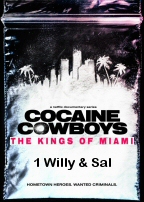
A Six-part Saga on the South Florida traffickers indicted in one of the largest drug cases in U.S. history. Alleged to be the chief U.S. distributors for two of Colombia's biggest cartels, Cuban exiles Augusto 'Willy' Falcon and Salvador 'Sal' Magluta were accused of smuggling over 75 tons of cocaine into the U.S. in the 1980s. The high school friends built a reputed $2 billion empire that made Willy and Sal two of Miami's biggest celebrities. Featuring colourful interviews with those closest to them, their defence team, and the Feds tasked with taking them down, the series paints a vivid portrait of the last of Miami's 'cocaine cowboys.' The first episode shows how in the 1970s and '80s, friends Willy Falcon and Sal Magluta leave humble beginnings behind as they allegedly ascend to the top of Miami's drug trade.
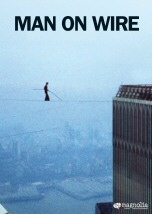
On August 7th, 1974, a young Frenchman named Philippe Petit stepped out on a wire illegally rigged between the New York World Trade Center’s twin towers. After dancing for nearly an hour on the wire, he was arrested, taken for psychological evaluation, and brought to jail before he was finally released. This extraordinary documentary incorporates Petit’s personal footage to show how he overcame seemingly insurmountable challenges to achieve the 'Artistic crime of the century'.








Hubble’s incredible discoveries have allowed scientists to piece together much of our cosmic story, but it cannot take us back to the most important moment in history: the Big Bang. For decades, the moment the universe began was the subject of pure speculation, but by combining astronomy and cosmology, scientists have finally found a way to put their theories to the test and study the momentous events that took place during the Big Bang. They can do this because the European Space Agency’s Planck space telescope has seen the afterglow of the Big Bang itself – something we call the Cosmic Microwave Background. The unparalleled detail Planck gave us has helped confirm something remarkable: the Big Bang may not be the beginning. There was a time before the dawn – a place beyond anything we can comprehend. Professor Brian Cox transports us back to the fraction of a second before the Big Bang, when the seeds of our universe were planted.