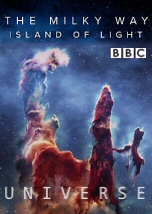
Professor Brian Cox continues his epic exploration of the cosmos by looking at the faint band of light that sweeps across the night sky - our own galaxy, the Milky Way. The Sun is just one of almost 400 billion stars that form this vast, majestic disk of light, our own home in the universe. Thanks to a cutting-edge space we’re finally able to reveal the Milky Way’s dramatic history and predict its cataclysmic future. Our galaxy started out a fraction of the size it is today, and Gaia telescope has revealed how it grew over the eons. Beautifully rendered VFX based on the very latest Gaia data has uncovered the remarkable story of our galaxy’s evolution. As our young galaxy encountered rival galaxies, it experienced a series of violent growth spurts and intense periods of cataclysmic change while battling to survive. Each time our galaxy feeds, a new era of star formation begins, fuelled by incoming torrents of fresh gas and energy. And there is another collision to come. Another, larger galaxy is coming our way. Andromeda is heading straight for us at a quarter of a million miles per hour. The Milky Way’s long-term fate is in the balance.
The centre of our galaxy is home to an invisible monster of unimaginable power – a supermassive black hole named Sagittarius A star, with four million times the mass of the Sun. Recent astronomical breakthroughs have confirmed not only that black holes like Sagittarius A star exist, but that these bizarre invisible objects may be the ultimate galactic protagonists. Stunning CGI takes us back to witness the fiery origins of our galaxy’s black hole 13.6 billion years ago, when the early universe was home to colossal blue stars, and when they ran out of fuel, they collapsed under their own enormous mass, crushing down into an object so small and so dense it punched a hole in the fabric of the universe. Over billions of years, Sagittarius A star feasted on nearby gas, stars, and through cataclysmic mergers with other black holes. A breakthrough discovery by Nasa’s Fermi gamma-ray telescope has shown that our black hole had the power to sculpt the entire galaxy, creating vast bubbles of gas above and below our galaxy and even protecting stars systems as ours. In a mind-bending conclusion, Brian Cox reveals how our modern understanding of black holes is challenging our concepts of reality to the breaking point. In trying to understand the fate of objects that fall into Sagittarius A star, scientists have come to a stunning conclusion: space and time, concepts so foundational to how we experience the world around us, are not as fundamental as we once thought.
They have the raw talent, but can they handle the pressure? Now Yuki Tsunoda and Esteban Ocon must sink or swim in the rough waters of Formula 1. Yuki Tsunoda had to move from Tokyo to Milton Keynes and F1 cars are proving a bit more difficult to wield than the F2 machine in which he won races. Esteban Ocon is part of the all-French attack (from Enstone) in the shape of Alpine, soaking up the pressure to win the Hungarian GP.
The meteoric rise of renewable energy has consequences for our electricity supply. While coal and gas fired power stations can generate electricity whenever you need it, renewables are intermittent by nature. So we need a backup plan for when the wind stops or the sun goes down. All over the world, engineers and scientists are racing to solve one key problem; how to safely and efficiently store electricity at a huge scale but at a low cost. The quest is producing some truly remarkable ideas and this episode details three of them.
Female Isisaurus traverse the Deccan Traps to reach their nesting site. A mixed herd of sauropods and Prenocephale navigate a maze of canyons, but are ambushed by a pack of Velociraptor and a trio of Tarbosaurus. A colony of male Corythoraptor protect their eggs from the scorching sun by day, and a female Kuru kulla at night, who has offpsring of her own. Trudging through a scorching desert, two young Tarchia find relief at an oasis and encounter an adult twice their size, ready to lay claim. Several Isisaurus hatchlings fall prey to Rajasaurus in an attempt to reach their ancestral home.
New discoveries have rewritten the history of our solar system, revealing a complex and violent story that begins with the birth of our Sun from the debris of a massive galactic collision, to its eventual fate as a lone zombie star. It is a dramatic history of elegant beauty and extreme violence. The inner solar system was like a congested highway. Planets crossing lanes, frequent collisions. There were a lot of planets that could have made it but didn't, and we just happen to be one of the lucky ones that did. The players in our solar system's story are more tangled up than we ever imagined. Without all of these things interplaying, the Earth wouldn't have the stable environment that we have today, and life wouldn't be able to exist.























Our galaxy started out a fraction of the size it is today, and Gaia telescope has revealed how it grew over the eons. Beautifully rendered VFX based on the very latest Gaia data has uncovered the remarkable story of our galaxy’s evolution. As our young galaxy encountered rival galaxies, it experienced a series of violent growth spurts and intense periods of cataclysmic change while battling to survive. Each time our galaxy feeds, a new era of star formation begins, fuelled by incoming torrents of fresh gas and energy. And there is another collision to come. Another, larger galaxy is coming our way. Andromeda is heading straight for us at a quarter of a million miles per hour. The Milky Way’s long-term fate is in the balance.