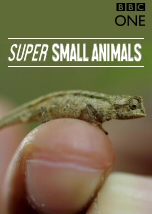
From a primate that’s no bigger than a mouse, to a chameleon that can fit on your fingertip, the natural world is full of fantastically small animals. Biologist Patrick Aryee explores the fascinating secrets behind these miniature marvels and shows that they’re not the underdogs you might think they are. Super Small Animals follows him as he meets the leading experts on these pint sized superstars, and finds out what makes them some of the most successful on the planet. First up, he reveals the huge benefits that being small can bring. There’s the little lemur whose diminutive frame helps it to exploit a unique gap in the eco-system, the tiny hummingbird that uses its size to out-maneuver the competition, and the world’s smallest seahorse that never has to leave home. He also explores why small animals are proportionally the strongest in the world, and introduces a peanut-sized beetle that can pull over a thousand times its own weight. Next he explores the challenges that animals face when they shrink in size, and the ingenious ways they overcome them. We find out how the smallest armadillo in the world manages to control its temperature in the searing desert sun, and the how the world’s smallest fish can survive in nothing more than a puddle, because it never really grows up. Patrick meets a secretive hippo that lives in the dense jungle, and looks like it’s been shrunk in the wash, and some of the world’s smallest snakes that give birth to enormous babies. He also meets a scientist that studies how really tiny spiders have a surprising trick that enables them to travel an incredible 40 miles per day, using almost no energy. Then there are the animals that refuse to be pigeon holed as small, and manage to punch way above their weight. He puts some astonishing invertebrates to the test, to see how they work together to become much bigger than the sum of their parts and meets a pint-sized predator that takes on some of the largest and most dangerous creatures on the planet, getting hands on to discover how its build helps it to be brave. Finally he uncovers the incredible lengths that deep sea anglerfish go to in order to be big and small at the same time, and has an endearing encounter with a tiny carnivore that manages to be small in just one direction. Whether their size helps them to hunt, hide or survive, all these remarkable animals prove that good things really do come in small packages.
What's worse for us: sugar or fat? To answer the hottest question in nutrition, twin doctors Chris and Xand Van Tulleken go on month-long high-fat and high-sugar diets. The effects on their bodies are shocking and surprising. But they also discover that in the debate about fat and sugar, the real enemy might have been hiding in plain sight.
In March 2022, the Russian army was closing in on the Ukrainian capital of Kyiv, and it was expected to fall in a short period of time. But in fact, many citizens chose to remain in their beloved city and provide resistance in whatever way they could. Despite daily missile attacks and the fear of an impending urban war, they were united in their efforts to protect their freedom and democracy. This documentary looks at the people of Kyiv through the eyes of a Ukrainian filmmaker.
In the concluding episode of the series, Jim encounters ever larger cosmic structures to reveal the latest breakthroughs in our understanding of the universe. For example, Jim comes face to face with our galactic home, the Milky Way, a monstrous structure sculpted by the gravitational forces of dark matter. Jim finds out from pioneering researcher Adrian Fabian about the black hole at its centre, whose strange behaviour includes emitting the lowest note that can be heard in the cosmos. At an even greater scale, Jim encounters huge structures such as the Laniakea Supercluster, of which the Milky Way is only a tiny part. Then there’s the 'Giant Arc', a collection of galaxies that account for more than three per cent of the observable universe. Jim learns from its discoverer, British PhD student Alexia Lopez, that this gargantuan structure is forcing scientists to reassess their theory of how the universe evolves and may overturn some of the most fundamental principles in physics.
The global financial meltdown that took place in Fall 2008 caused millions of job and home losses and plunged the United States into a deep economic recession. Matt Damon narrates a documentary that provides a detailed examination of the elements that led to the collapse and identifies keys financial and political players. Director Charles Ferguson conducts a wide range of interviews and traces the story from the United States to China to Iceland to several other global financial hot spots. 'Inside Job' provides a comprehensive analysis of the global financial crisis of 2008, which at a cost over $20 trillion, caused millions of people to lose their jobs and homes in the worst recession since the Great Depression, and nearly resulted in a global financial collapse. Through exhaustive research and extensive interviews with key financial insiders, politicians, journalists, and academics, the film traces the rise of a rogue industry which has corrupted politics, regulation, and academia.
This highly anticipated psychedelic docuseries showcases what these substances teaches people about consciousness, dying, addiction, depression and transcendence. Filmmaker Alex Gibney and best-selling author Michael Pollan present it in four parts, each focused on a different mind-altering substance: LSD, psilocybin, MDMA, and mescaline. With Pollan as our guide, we journey to the frontiers of the new psychedelic renaissance -- and look back at almost-forgotten historical context -- to explore the potential of these substances to heal and change minds as well as culture. The first chapter is a great introduction to the topic of LSD, from its 1943 origins to today's microdosing trend, for those who don’t already know a lot about the subject, and a fun and entertaining refresher on LSD for even experts in the field. The show takes us on a journey through the history of the powerful compound, from its discovery and its early medical use, to secret CIA mind-control studies, the counterculture and its banning, and finally to our current renaissance. It includes amazing clips of LSD’s inventor Albert Hofmann and powerful personal testimonies of individuals who have healed their suffering through LSD.













First up, he reveals the huge benefits that being small can bring. There’s the little lemur whose diminutive frame helps it to exploit a unique gap in the eco-system, the tiny hummingbird that uses its size to out-maneuver the competition, and the world’s smallest seahorse that never has to leave home. He also explores why small animals are proportionally the strongest in the world, and introduces a peanut-sized beetle that can pull over a thousand times its own weight.
Next he explores the challenges that animals face when they shrink in size, and the ingenious ways they overcome them. We find out how the smallest armadillo in the world manages to control its temperature in the searing desert sun, and the how the world’s smallest fish can survive in nothing more than a puddle, because it never really grows up. Patrick meets a secretive hippo that lives in the dense jungle, and looks like it’s been shrunk in the wash, and some of the world’s smallest snakes that give birth to enormous babies. He also meets a scientist that studies how really tiny spiders have a surprising trick that enables them to travel an incredible 40 miles per day, using almost no energy.
Then there are the animals that refuse to be pigeon holed as small, and manage to punch way above their weight. He puts some astonishing invertebrates to the test, to see how they work together to become much bigger than the sum of their parts and meets a pint-sized predator that takes on some of the largest and most dangerous creatures on the planet, getting hands on to discover how its build helps it to be brave. Finally he uncovers the incredible lengths that deep sea anglerfish go to in order to be big and small at the same time, and has an endearing encounter with a tiny carnivore that manages to be small in just one direction.
Whether their size helps them to hunt, hide or survive, all these remarkable animals prove that good things really do come in small packages.