





Last Watched

"Milk"  Sort by

When Knowledge Conquered Fear

   2014    Science
The episode begins with Tyson describing how pattern recognition manifested in early civilization as using astronomy and astrology to predict the passing of the seasons, including how the passage of a comet was often taken as an omen. Tyson continues to explain that the origin of comets only became known in the 20th century due to the work of Jan Oort and his hypothesis of the Oort cloud. Tyson then continues to relate the collaboration between Edmond Halley and Isaac Newton in the last part of the 17th century in Cambridge. The collaboration would result in the publication of Philosophiæ Naturalis Principia Mathematica, the first major work to describe the laws of physics in mathematical terms, despite objections and claims of plagiarism from Robert Hooke and financial difficulties of the Royal Society of London. Tyson explains how this work challenged the prevailing notion that God had planned out the heavens, but would end up influencing many factors of modern life, including space flight. Tyson further describes Halley's contributions including determining Earth's distance to the sun, the motion of stars and predicting the orbit of then-unnamed Halley's Comet using Newton's laws. Tyson contrasts these scientific approaches to understanding the galaxy compared to what earlier civilizations had done, and considers this advancement as mankind's first steps into exploring the universe. The episode ends with an animation of the Milky Way and Andromeda galaxies' merging based on the principles of Newton's laws.
Series: Cosmos: A Spacetime Odyssey
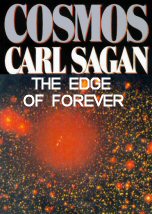
The Edge of Forever

   1980    Science
Beginning with the origins of the universe in the Big Bang, Sagan describes the formation of different types of galaxies and anomalies such as galactic collisions and quasars. The episodes moves further into ideas about the structure of the Universe, such as different dimensions (in the imaginary Flatland and four-dimensional hypercubes), an infinite vs. a finite universe, and the idea of an oscillating Universe (similar to that in Hindu cosmology). The search into other ideas such as dark matter and the multiverse is shown, using tools such as the Very Large Array in New Mexico. Cosmos Update shows new information about the odd, irregular surfaces of galaxies and the Milky Way perhaps being a barred spiral galaxy
Series: Cosmos

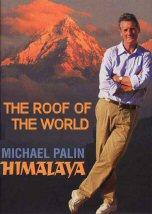
The Roof of the World

   2004    Culture
Leaving Everest base camp to take the high road to Lhasa to see what the Chinese have done to Tibet. He sees that religion is once again tolerated, while the old Tibetan centre of the city is being replaced with modern Chinese shopping malls and nightclubs. Following the pilgrims to the holy Namtso Lake, he gets warm in a hot spring before learning how to milk a yak with a nomad family.
Series: Himalaya with Michael Palin

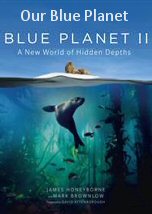
Our Blue Planet

   2017    Nature
Blue Planet II explores parts of the ocean that nobody has ever visited, encountered extraordinary animals, and discovered new insights into life beneath the waves. In Our Blue Planet, Sir David Attenborough examines the impact of human life on life in the ocean. In this final episode, we uncover the impact that our modern lives are having on our best-loved characters from across the series, including devoted albatross parents unwittingly feeding their chicks discarded plastic and mother dolphins potentially exposing their new born calves to pollutants through their contaminated milk. Scientists have even discovered that increasing noise levels may stop baby clownfish finding their way home.
Series: Blue Planet II

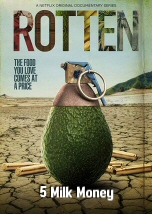
Milk Money

   2018    Nature
Changing diets and dramatic price swings have put dairy farmers on the ropes and fueled a surge in lucrative but controversial raw milk sales. Proponents of raw milk have stated that there are benefits to its consumption, including better flavour, better nutrition, and the building of a healthy immune system. However, the medical community has warned of the dangers, which include a risk of infection, and has not found any clear benefit
Series: Rotten

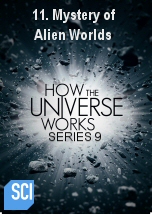
Mystery of Alien Worlds

   2021    Science
Exoplanets, strange worlds outside our solar system. We're discovering the cosmos is full of alien planets. Alien worlds that challenge our understanding of planetary systems. Hellishly hot worlds, violently colliding worlds, worlds getting eaten by their stars. There's much, much more out there than we had ever imagined.
Exoplanets are shaking up our understanding of the universe. The cosmos is a chaotic array of the odd, the weird, and the wonderful. The more we find, the less we know.
Series: How the Universe Works Series 9
Human: The World Within

Human: The World Within

2021  Medicine
Generation Iron

Generation Iron

2018  History
How to Stay Young

How to Stay Young

2016  Medicine
Food Inc

Food Inc

2009  Technology
Leaving Neverland

Leaving Neverland

2019  Culture
Kingdom

Kingdom

2025  Nature
The Universe

The Universe

2011  Science