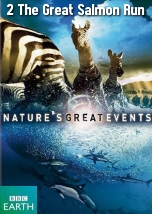
Every year grizzly bear families in North America depend for their survival on a spectacular natural event: the return of hundreds of millions of salmon from the Pacific Ocean to the mountain streams where they were born. The salmon travel thousands of miles to spawn and then die. The great run not only provides food for bears, but for killer whales, wolves, bald eagles, and even the forest itself. The question is: will the salmon return in time to keep hungry bears alive? A mother grizzly and her cubs emerge from their den high in snowy Alaskan mountains. Filming from the air the team capture a TV first, following the bears as they negotiate a near vertical slope on their journey to the coast where they await the return of the salmon. Meanwhile, the salmon are making their way to the to river mouths where they must swim upstream and against the current. The programme reveals how they tackle the torrents and leap over waterfalls, a feat equivalent to a human jumping over a house. Dozens of hungry bears eagerly await the salmon that make it up river. In another TV first, underwater cameras record the ingenuity and fancy footwork they use to collect dead salmon from the bottom of deep pools.
The story of Tilikum, a captive killer whale that has taken the lives of several people , including a top killer whale trainer, underscores the consequences of keeping these powerful animals in captivity, the problems within the sea-park industry, the man's relationship to nature, and how little has been learned about these highly intelligent and sentient mammals. Tilikum was captured in the northern Atlantic Ocean in 1983 and taken to Sealand of the Pacific, a now-shuttered park near Victoria, British Columbia. Former Sealand trainers interviewed in 'Blackfish' say the park’s female killer whales would aggressively gang up on Tilikum, particularly when they were confined in a 20-foot-by- 30-foot pool overnight.
600 miles off the coast of South America in the Pacific Ocean there are 120 tropical islands that erupted from the deep ocean floor more than 10 million years ago. Journey from the lava ramparts to its fiery heart, we'll discover how the Galapagos archipelago became one of the most important areas of biodiversity in the world. Those swept here by storms and currents survived million to one odds to find untouched islands free from competition. These hardy pioneers evolved in remarkable ways in what's known as Nature's Greatest Experiment. Home to bizarre specialists and unexpected giants, the most precious collection of island creatures on Earth.
In Southeast Alaska, there's an ice-bound Eden that harbors possibly the richest temperate rainforests of all. Where the coastal mountains meet the Pacific, lays the Alexander Archipelago, a remote island chain running for almost 300 miles along the Alaskan Panhandle. This frozen frontier is one of the last great wildernesses of North America. And a stronghold for the country's highest diversity of megafauna, feasting on the abundance of fleeting summers to make it through relentless winters.
In changing seas and oceans, cephalopods like the cuttlefish and the giant Pacific octopus must rely on their remarkable intelligence to survive. Their alien appearance comes with astonishing resources, independence, and invention. And there's still so much to learn about these rarely seen legends of the deep.
On the trail of tiger sharks in the Pacific, Will Smith explores the power of smell. Sharks have a sense of smell that's hundreds of times more potent and accurate than that of humans. An enormous part of their brain is dedicated to smelling, to finding their way through the vast expanse of the ocean.

























A mother grizzly and her cubs emerge from their den high in snowy Alaskan mountains. Filming from the air the team capture a TV first, following the bears as they negotiate a near vertical slope on their journey to the coast where they await the return of the salmon. Meanwhile, the salmon are making their way to the to river mouths where they must swim upstream and against the current. The programme reveals how they tackle the torrents and leap over waterfalls, a feat equivalent to a human jumping over a house. Dozens of hungry bears eagerly await the salmon that make it up river. In another TV first, underwater cameras record the ingenuity and fancy footwork they use to collect dead salmon from the bottom of deep pools.