









Last Watched

"AGI"  Sort by

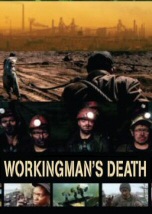
Workingman Death

   2005    Culture
Austrian director Michael Glawogger travels to five countries to focus on some of the worst jobs imaginable: Ukrainian miners crawl into tiny cracks in old coal pits to scratch out a few bags of winter fuel; Indonesian workers trudge long distances carrying baskets with hundreds of pounds of sulfur chunks extracted from a steaming mountain; Pakistanis risk explosions and burial under tons of scrap iron as they dismantle huge carrier ships. The visuals are everything here. Despite the hardships depicted, many sequences have a dreamlike beauty. In addition, the director has a bone-dry sense of irony; during the Ukraine scenes, he frequently cuts away to a statue of Stakhanov, the "hero" lauded by the Soviets for his superhuman work habits. He also shows us an old German smelting works that's been converted into a theme park.

Who Will We Be

   2015    Medicine
In ‘Who will we be?’ Dr. David Eagleman journeys into the future, and asks what’s next for the human brain, and for our species. We stand at a major turning point, one where we might take control of our own development. We face a future of uncharted possibilities in which our relationship with our own body, our relationship with the world, the very basic nature of who we are is set to be transformed. For thousands of generations, humans have lived the same life cycle over and over. We are born, we control a fragile body, we experience a limited reality, and we die. But science and technology are giving us tools to transcend that evolutionary story. Our brains don't have to remain as we have inherited them. We are capable of extending our reality, of inhabiting new bodies, and possibly shedding our physical forms altogether. And we are discovering the tools to shape our own destiny. Who we become is up to us.
Series: The Brain with David Eagleman

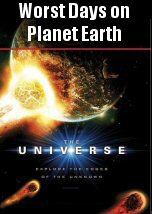
Worst Days on Planet Earth

   2011    Nature    3D    HD
Earth may seem like the most hospitable planet in the solar system. But look again. Startling new discoveries reveal the blue planet has been plagued by more chaos and destruction than scientists once imagined. Stand on the Earth billions of years ago as a primitive planet called Theia slams into it. Shiver as our entire globe is frozen over like a gigantic snowball. Feel the heat as mammoth volcanoes scorch the landscape and darken the sky. From a cosmic gamma ray burst frying away the ozone layer to an Everest-size asteroid slamming into the ocean, we'll reveal new information about how these unparalleled events drove life to the brink of total extinction. Out of this continuous devastation, how has our planet--and life--got to where it is today? Are the worst days behind us--or lurking in the distant future?
Series: The Universe

Beyond the Rainbow

   2015    Science
Helen Czerski ventures beyond the visible spectrum in the final (and best) episode in this vibrant series, showing how electromagnetic radiation is so much broader than the narrow slice of reality we see with our eyes. Before delving into the details of UV, infrared and x-rays, Dr Czerski explores colour subjectivity by trying on a dress that recently divided the internet — to some it appeared blue and black, to others white and gold. It's a perfect fit. It's also a neat analogy of how people can have opposing views but both swear blind that their perspective is correct. The series ends with some amazing imaging techniques that show our bodies in a whole new light.
Series: Colour The Spectrum of Science

How Big How Far How Fast

   2012    Science
Push the limits of your imagination as astronomers attempt to grasp the mind-boggling extremes of size, distance and speed within our universe by bringing them down to earth. In this episode, our cast uses awesome analogies to bring the biggest objects, farthest distances and fastest speeds down to earth. To truly understand the scale of the cosmos, we jump behind the wheel of monster trucks, scale the Golden Gate Bridge, and race across the desert in a rocket-powered car.
Series: The Universe

Steve Jobs Man in the Machine

   2015    History
Directed by Alex Gibney, it follows the life and work of ex-Apple CEO Steve Jobs. Gibney starts the doc by showing how much people around the world worship Steve Jobs as if he were an idol. He then provides you with a wealth of background information about Jobs' childhood, teenage and college years including how he formed Apple Inc. Fortunately, not all of the doc is hagiography because Gibney does briefly delve into the darker side of Jobs, particularly how selfish he was and mistreated those around him including his ex-wife. Jobs comes across as a charming, intelligent narcissist who knows how to captivate an audience whenever he speaks. In other words, like all great narcissists, he's a very good actor. Gibney certainly knows how to choose the right subject because Jobs' complexity makes him all the more captivating and worthy of a feature-length film. As is usually the case with Gibney's docs, this one is slickly-edited and has just the right amount of comic relief, mostly in the brief video of an young boy joyfully lists all of Apple's technological devices that Steve Jobs created. You'll catch a glimpse of what makes Jobs fallible, and find a little mildly provocative food for thought about the advancement of modern technology, i.e. how technology helps to connect us to one another yet alienates us at the same time.
Walking with Dinosaurs

Walking with Dinosaurs

2025  Science
Unknown

Unknown

2023  Science
Super/Natural

Super/Natural

2022  Nature
The Cell

The Cell

  Science
Black Hole Apocalypse

Black Hole Apocalypse

2018  Science
Mammals

Mammals

2024  Nature