



Last Watched

"Ape"  Sort by

Ice

   2007    Nature
Our icy adventure begins with host Dr. Iain Stewart in the Alps, where he goes down an ice crevasse to show viewers how snowfall develops into expansive masses. Then, we see how ice can shape the earth's topography giving rise to features like Yosemite National Park and Manhattan Island, in NY. Finally, journey to Greenland and see how ice sheets and glaciers are melting at a phenomenal rate that is likely to accelerate over the coming years, changing the world as we know it.
Series: Earth, The Power of the Planet
The Oceans

   2007    Nature
Earth’s oceans help make our planet different from every other planet in the solar system. As far as we know, no other place is the right temp for liquid water, the most essential ingredient for life to exist. The oceans are Earth’s primary stabilizing force, and their immense power helps to shape the appearance and behavior of the entire planet and everything living on it. And they are also the planet's great unknown - their deepest points have been visited less than the surface of the moon.
Series: Earth, The Power of the Planet
Dragons of the Dry

   2008    Nature
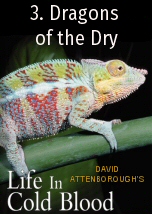
About 340 million years ago a brand new family of animals was evolving in the primeval swamps. They were to go one step further than the amphibians who had emerged onto dry and before them. For they would eventually completely cut their ties with water. They were the ancestors of todays lizards. They evolved scaly impermeable skins and moved up into the forests. They diversified into a multitude of different shapes and sizes. They developed signalling systems to communicate with one another. And they squabbled as animals do. For food they hunted insects that were already well established on the land in great numbers. And here without returning to water they produced their families. They powered their bodies not only with food but with the heat that they drew directly from the sun.
As they diversified so they spread into the harshest of the lands habitats. The baking waterless deserts which eventually they would come to dominate. Discover jacky lizards that wave, wrestling beaded lizards and the the world's smallest chameleon, which is no bigger than his thumbnail, and the biggest lizard in Australia.
Series: Life In Cold Blood

Frozen Planet: Winter

   2011    Nature
There is no greater test for life than winter, as temperatures plummet to 70 below and winds reach 200kph. Darkness and ice extend across the polar regions and only a few remarkable survivors gamble on remaining. We join a female polar bear trekking into the Arctic mountains to give birth as the first blizzards arrive. Out on the frozen ocean, the entire world's population of spectacled eider ducks brave the winter in a giant ice hole kept open by ferocious currents. Arctic forests transform into a wonderland of frost and snow - the scene of a desperate and bloody battle between wolf and bison, but also where a remarkable alliance between raven and wolverine is made. Beneath the snow lies a magical world of winter survivors. Here tiny voles dodge the clutches of the great grey owl, but cannot escape the ultimate under-show predator - the least weasel. Midwinter and a male polar bear wanders alone across the dark, empty icescape. Below the snow, polar bear cubs begin life in an icy den while fantastical auroras light the night skies above. In Antarctica, we join male emperor penguins in their darkest hour, battling to protect precious eggs from fierce polar storms. Weddell seals escape to a hidden world of jewel-coloured corals and alien-looking creatures but frozen devastation follows as sinister ice stalactites reach down with deadly effect.
Series: Frozen Planet

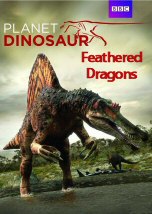
Feathered Dragons

   2011    Culture
In a late Jurassic forest in what is now China, an Epidexipteryx escapes from a juvenile Sinraptor by climbing a tree. It finds a beetle grub in the tree bark, being shown to use its elongated fingers in a similar way to a modern day aye-aye. However, its prey is stolen by another, larger Epidexipteryx, and after a brief bout of posturing, the smaller individual goes to find more food. It drops a second grub to the forest floor, where the other Epidexipteryx retrieves it, only to be killed by the juvenile Sinraptor. The episode then cuts to a desert in late Cretaceous Mongolia, where a Saurornithoides is shown brooding a nest of eggs. When it leaves the nest, an Oviraptor raids it, fleeing when the troodontid returns. The Saurornithoides is suddenly attacked and eaten by a Gigantoraptor, which then heads to compete in a breeding ritual for mates. The males use their feathers for display, a brief fight between two erupting at one point, allowing the females to choose the best suitor. The episode finally cuts to an early Cretaceous forest in China, where a Xianglong is being hunted by a Microraptor, which uses its feathers to pursue the gliding lizard in the air. A Sinornithosaurus attacks it, and after a brief chase the Microraptor manages a lucky escape. The Sinornithosaurus, alongside two other members of its species is then shown hunting a Jeholosaurus and its three young. The group brings down the parent, the narrator explaining that their possibly venomous bite allowed them to tackle animals much larger than themselves. A montage is then shown of the feathered dinosaurs featured in the programme, with the narrator saying that Microraptor not only hints at how flight might have developed, but also that dinosaurs still live amongst us today, as birds.
Series: Planet Dinosaur

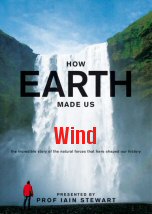
Wind

   2010    Science
Iain sets sail on one of the fastest racing boats ever built to explore the story of our turbulent relationship with the wind. Travelling to iconic locations including the Sahara desert, the coast of West Africa and the South Pacific, Iain discovers how people have exploited the power of the wind for thousands of years. The wind is a force which at first sight appears chaotic. But the patterns that lie within the atmosphere have shaped the destiny of continents, and lie at the heart of some of the greatest turning points in human history.
Series: How Earth Made Us