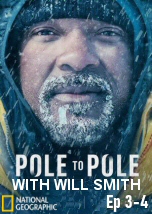
Inspired by his late mentor, Will Smith embarks on a 100-day, pole-to-pole odyssey that pushes him far beyond his comfort zone. Traveling alongside scientists, explorers, and local experts, he climbs remote mountains, dives beneath polar ice, and confronts the raw power of nature. The journey blends adrenaline and curiosity, revealing how extreme environments shape life—and how facing the planet’s edges can reshape us, too. In the first two episodes, the adventure begins with sweeping ambition and immediate immersion. Smith sets out on the global route with National Geographic, then plunges into the Amazon rainforest, tracking dangerous wildlife and learning from those who know the jungle best. It’s a vivid opening that sets the tone for a quest defined by discovery, risk, and awe at the natural world.
In episodes 3 and 4, the journey intensifies as Will Smith pushes deeper into both the physical and emotional extremes of the planet. In the Amazon, he ventures into dense, unforgiving jungle in search of the elusive green anaconda, confronting fear, danger, and the raw power of one of Earth’s most mysterious predators. Guided by local experts, the expedition becomes a test of courage and trust in a world where nature sets all the rules. The adventure then shifts dramatically to the Himalayas, where the challenge is no longer survival but meaning. High above the clouds, Will explores the idea of happiness alongside monks, scientists, and mountain communities, discovering how isolation, altitude, and ancient wisdom reshape the human mind. Together, these episodes connect the wildness of nature with the inner journey of self-discovery, revealing that the greatest expedition may be the one within.
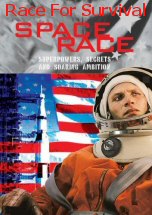
During 1959-1961 both the Americans and Soviets are planning manned space flight, and we see both sides preparing to do so with the development of the Vostok programme (Russia) and Project Mercury (USA). After difficulties and failures on both sides, the Soviets succeed in putting Yuri Gagarin into space first, with the Americans putting Alan Shepard up shortly afterwards.
Garry Kasparov is arguably the greatest chess player who has ever lived. In 1997 he played a chess match against IBM's computer Deep Blue. Kasparov lost the match. This film shows the match and the events surrounding it from Kasparov's perspective. It delves into the psychological aspects of the game, paranoia surrounding it and suspicions that have arisen around IBM's true tactics. It consists of interviews with Kasparov, his manager, chess experts, and members of the IBM Deep Blue team, as well as original footage of the match itself.















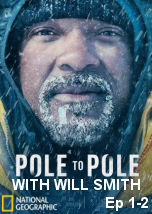






In the first two episodes, the adventure begins with sweeping ambition and immediate immersion. Smith sets out on the global route with National Geographic, then plunges into the Amazon rainforest, tracking dangerous wildlife and learning from those who know the jungle best. It’s a vivid opening that sets the tone for a quest defined by discovery, risk, and awe at the natural world.