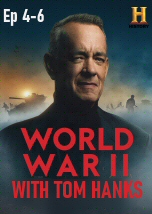
In these three episodes, we see how Japan’s war in China, U.S. sanctions, and the desperate search for vital resources push the Pacific toward a decisive breaking point. Driven by military ambition and imperial ideology, Japan launches the attack on Pearl Harbor, shocking the world and bringing America fully into World War II. From that moment, the conflict becomes a vast struggle across oceans, supply lines, naval codes, aircraft carriers, submarines, and nations fighting for survival. The story then moves into the brutal battle for control of the seas, where German U-boats threaten Britain’s lifeline in the Atlantic while Japan’s powerful navy tries to dominate the Pacific. After Pearl Harbor, Japanese forces sweep through Southeast Asia with alarming speed, but on Guadalcanal their advance meets fierce resistance. In the jungle, at sea, and in the air, U.S. Marines face exhaustion, fear, and relentless combat in one of the first great tests of America’s resolve in the Pacific.
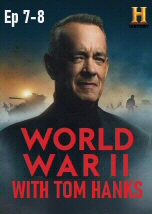
In episodes 7 and 8, we see how World War II descends into one of the darkest chapters in human history while the Allies prepare to strike back for the first time on a new front. As Hitler’s power spreads across Europe, Nazi hatred turns persecution into policy, pushing Jewish families from discrimination and public humiliation into ghettos, deportations, mass murder, and the horror that will become known as the Holocaust. The war is no longer only a struggle for territory, armies, and empires; it becomes a confrontation with an ideology built on cruelty, fear, and the destruction of an entire people. The story then shifts to North Africa, where the Western Allies must prove they can fight Germany on land. In Operation Torch, inexperienced American troops and their untested commander, Dwight D. Eisenhower, join British forces in a dangerous gamble against the battle-hardened Afrika Korps and the legendary Erwin Rommel. Across deserts, ports, and unforgiving battlefields, the campaign becomes a harsh lesson in modern war, exposing Allied weaknesses while opening the road toward Europe. These two episodes combine moral catastrophe and military turning point, showing both the depths of Nazi evil and the first difficult steps toward its defeat.
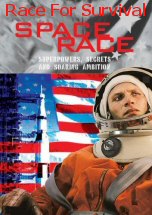
During 1959-1961 both the Americans and Soviets are planning manned space flight, and we see both sides preparing to do so with the development of the Vostok programme (Russia) and Project Mercury (USA). After difficulties and failures on both sides, the Soviets succeed in putting Yuri Gagarin into space first, with the Americans putting Alan Shepard up shortly afterwards.
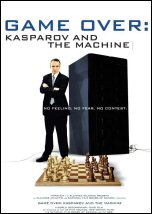
Garry Kasparov is arguably the greatest chess player who has ever lived. In 1997 he played a chess match against IBM's computer Deep Blue. Kasparov lost the match. This film shows the match and the events surrounding it from Kasparov's perspective. It delves into the psychological aspects of the game, paranoia surrounding it and suspicions that have arisen around IBM's true tactics. It consists of interviews with Kasparov, his manager, chess experts, and members of the IBM Deep Blue team, as well as original footage of the match itself.






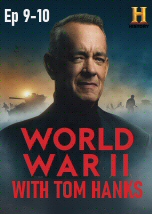












The story then moves into the brutal battle for control of the seas, where German U-boats threaten Britain’s lifeline in the Atlantic while Japan’s powerful navy tries to dominate the Pacific. After Pearl Harbor, Japanese forces sweep through Southeast Asia with alarming speed, but on Guadalcanal their advance meets fierce resistance. In the jungle, at sea, and in the air, U.S. Marines face exhaustion, fear, and relentless combat in one of the first great tests of America’s resolve in the Pacific.