Humans have long gazed up at the night sky, wondering whether other lifeforms and intelligences could be thriving on worlds far beyond our own. But over the last few decades, ultra-sensitive telescopes and dogged detective work have transformed alien planet-hunting from science fiction into hard fact. We expected to find worlds similar to the planets in our own solar system, but we instead discovered a riot of exotic worlds. Vivid animation based on data from the most successful planet hunter of them all, the Kepler space telescope, brings these worlds into view: puffy planets with the density of polystyrene, unstable worlds orbiting two suns and 1,000-degree, broiling gas giants with skies whipped into titanic winds. But perhaps the most startling discovery was the number of worlds that may be contenders for a second Earth, at the right distance from their sun to have that ingredient so crucial for life as we know it, liquid water. Amongst them, we witness the most tantalizing discovery of all: a so-called ‘super-Earth’, situated in the Goldilocks zone - the area just the right distance from a sun to potentially support life - and with the faint signal of water in its atmosphere.
In just one generation, our ability to search for planets beyond our solar system has transformed. With modern techniques and telescopes, planetary scientists have found thousands of exoplanets in our universe, and many of them have the perfect conditions for life. Are we about to find Earth’s twin?
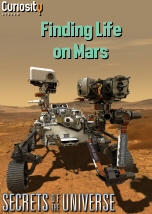
For decades, scientists have dreamed of finding life on Mars. But despite their best efforts, no signs of life have been found. Could that be about to change? This is the story of the scientists and engineers behind Perseverance: the rover that could change our view of Mars forever.
Mars is infested with robots, orbiting the planet and roaming the Martian surface on a mission to uncover its secrets; now, Perseverance joins this dedicated group of machines to uncover if there is, or was ever, life on the Red Planet. Our neighbor, Mars, fascinates us. It's a planet that is similar to Earth but with some big differences. Mars is rusty, dusty, frigid, and frozen. Past missions suggest that Mars was once a very different world. The Mars we see today has completely changed from the Mars of a few billion years ago. Without a time machine to explore ancient Mars, we employ a team of high-tech robot investigators, an entire fleet of robotic spacecraft exploring the planet. Working together, they dig into Mars's past to answer the ultimate question -- did Mars once have life?

























But perhaps the most startling discovery was the number of worlds that may be contenders for a second Earth, at the right distance from their sun to have that ingredient so crucial for life as we know it, liquid water. Amongst them, we witness the most tantalizing discovery of all: a so-called ‘super-Earth’, situated in the Goldilocks zone - the area just the right distance from a sun to potentially support life - and with the faint signal of water in its atmosphere.