




Last Watched

"Cell"  Sort by

Some of the Things That Molecules Do

   2014    Science    HD
The story begins with Tyson sitting at a campfire, and telling how the wolf changed through artificial selection, and selective breeding into the dog breeds around today. He then enters the Ship of Imagination, and explains natural selection with the process that helped to create the polar bears. Along the way he talks about DNA, genes and mutation. Next he goes to a forest and describes the Tree of life, this leads him to discussing the evolution of the eye. He then discusses extinction, by going to a monument called the Halls of Extinction, dedicated to the broken branches of the tree of life. Explaining the five great Extinction events. He then tells how some life has survived, and then focuses on the tardigrade. From there he talks about what other kinds of life might have been created on other worlds. He then goes to Saturn's moon Titan. From there he speculates about life and how it first began. He then returns to Earth and tells about abiogenesis and how life changed and evolved. The show ends with an animated sequence from the original series of life's evolution from one cell to humans.
Series: Cosmos: A Spacetime Odyssey
The Chemistry of Life

       Science
This episode explores how scientists delved ever deeper into the world of the cell, seeking to reveal the magic ingredient that can spark a bundle of chemicals into life. Their discoveries have brought us to the brink of being able to create life for ourselves.
Series: The Cell

The Spark of Life

       Science
The final part reveals how our knowledge of cells has brought us to the brink of one of the most important moments in history. Scientists are close to repeating what has happened only once in four billion years - the creation of a new life form.
Series: The Cell

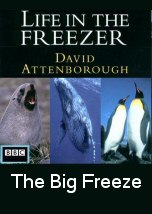
The Big Freeze

   1993    Nature
As almost all animal inhabitants of Antarctica are forced to migrate north, the sea underneath the frozen ice still provides a home to many specially adapted fish whose cells are protected from freezing through an 'antifreeze' liquid. Many of them feed on the faeces of other animals. The most notable larger animal that does not migrate north is perhaps the Weddell Seal, which can be found as close as 1300 kilometres to the pole. Groups of seals tear holes into the ice to dive for food and come up to breathe. The females come back to the ice to give birth. This episode also describes primitive plant life such as lichen, which can still be found on the continent in winter, even in the extremely dry and permanently frozen valleys conditions under which dead animals can lie frozen for many centuries without decomposing. It details the life of the Emperor Penguin, 'the only birds to lay their eggs directly on ice'. While other animals retreat, Emperors migrate not just to the ice, but into the Antarctic continent. The females lay eggs which are incubated by the males under the harshest conditions on Earth (huddling closely together for warmth), while the females return to the sea.
Series: Life in the Freezer

Does the Ocean Think

   2014    Science
There could be an undiscovered species on Earth unlike anything we’ve ever known. Not in the ocean, but the ocean itself! Its body spans thousands of miles; its heart beats with a one-thousand-year pulse. It could even have an immune system capable of annihilating all other life on earth. Just as our bodies function through the interaction of water with individual cells, including bacteria and other microorganisms, the ocean’s residents might collectively form a super-organism. A recent discovery suggests the ocean is a living being capable of thought. If so, what is the ocean thinking about us?
Series: Through the Wormhole Season 5

How to Live Longer

   2017    Medicine
Our lifespan is increasing by 2.5 years every decade - and a third of all babies born today can expect to live to 100. But living longer can come at a cost. Old age itself brings with it a range of debilitating illnesses, many of which are the result of accumulating damage during our lifetime. Three diseases in particular have become the main killers in the developed world - cancer, heart disease and dementia. But a revolution in bio-medicine is now offering new hope for the treatment of these ailments, and the potential to extend our lives still further. Methods such as gene editing and stem cell therapies are transforming the way medicine can conquer disease today. "How to Live Longer" counts with the guide of the Nobel laureate Sir Paul Nurse, for whom the big question isn't just what science can do to fix our bodies and extend our lives, but whether it's right to use all the tools and techniques available.
Series: The Big Think
Dangerous knowledge

Dangerous knowledge

2007  Science
The Universe

The Universe

2010  Science
Animal

Animal

2021  Nature
Wild South America

Wild South America

2005  Nature
First Life

First Life

2010  Science