








Last Watched

"Ming"  Sort by

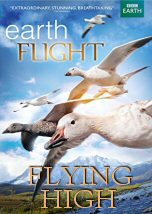
Flying High

   2012    Nature
To fly like a bird, Earthflight not only captured remarkable images of wild flocks but also relied on some extraordinary relationships between people and birds. Filmed over four years, in six continents and more than 40 countries, the Earthflight team used many extraordinary techniques. For some of the unique flying shots, members of the team became part of the flock. The birds followed wherever they went - even in a microlight over Edinburgh and London. In Africa, paragliders floated alongside wild vultures, while a model vulture carried a camera inside the flock. In South America, wild-living macaws, that were rescued as babies, still come back to visit their 'foster mother' as he travels along a jungle river. In Africa, a radio-controlled 'drone' silently infiltrates masses of pink flamingos without disturbing a feather, and microlights and helicopters capture the dramatic moment white storks arrive over Istanbul. In Africa a tame vulture carried a camera across the African bush and recreated the behaviour of his wild relatives. Similarly, in the USA, a flock of hand-reared snow geese followed the migration route of wild flocks and took in the sights and sounds of New York - managing to get lost in Brooklyn
Series: Earthflight
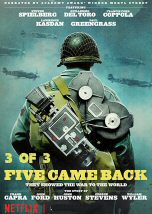

The Price of Victory

   2017    Art
The five directors, John Ford, William Wyler, John Huston, Frank Capra, and George Stevens, return to Hollywood after the war but are forever haunted by what they saw. Ford goes on a drinking bender after filming the carnage at D-Day. Stevens is wholly unprepared for the horrors of Dachau and realizes he is not there to film propaganda but to capture evidence of crimes against humanity. Wyler, who lost his hearing during the war, fears his career is over. Huston chronicles soldiers suffering from postraumatic stress disorder in the film Let There Be Light, only to have it suppressed by the U.S. government.
Series: Five Came Back

Fightback

       Nature
Dr Iain Stewart investigates the counter-attack that was launched by the global warming sceptics in the 1990s. At the start of the 1990s it seemed the world was united. At the Rio Earth summit the world signed up to a programme of action to start tackling climate change. Even George Bush was there. But the consensus didn't last.
Iain examines the scientific arguments that developed as the global warming sceptics took on the climate change consensus. The sceptics attacked almost everything that scientists held to be true. They argued that the planet wasn't warming up, that even if it was it was nothing unusual, and certainly whatever was happening to the climate was nothing to do with human emissions of greenhouse gases. Iain interviews some of the key global warming sceptics, and discovers how their positions have changed over time.
Series: The Climate Wars

Fight for the Future

       Nature
Having explained the science behind global warming, and addressed the arguments of the climate change sceptics earlier in the series, Dr Iain Stewart concludes the series by looking at the biggest challenge now facing climate scientists - Just how can they predict exactly what changes global warming will bring?
It's a journey that takes him from early attempts to model the climate system with dishpans, to supercomputers, and to the frontline of climate research today: Greenland. Most worryingly he discovers that scientists are becoming increasingly concerned that their models are actually underestimating the speed of changes already underway.
Series: The Climate Wars

The Great Salmon Run

   2009    Nature
Every year grizzly bear families in North America depend for their survival on a spectacular natural event: the return of hundreds of millions of salmon from the Pacific Ocean to the mountain streams where they were born. The salmon travel thousands of miles to spawn and then die. The great run not only provides food for bears, but for killer whales, wolves, bald eagles, and even the forest itself. The question is: will the salmon return in time to keep hungry bears alive?
A mother grizzly and her cubs emerge from their den high in snowy Alaskan mountains. Filming from the air the team capture a TV first, following the bears as they negotiate a near vertical slope on their journey to the coast where they await the return of the salmon. Meanwhile, the salmon are making their way to the to river mouths where they must swim upstream and against the current. The programme reveals how they tackle the torrents and leap over waterfalls, a feat equivalent to a human jumping over a house. Dozens of hungry bears eagerly await the salmon that make it up river. In another TV first, underwater cameras record the ingenuity and fancy footwork they use to collect dead salmon from the bottom of deep pools.
Series: Nature Great Events

The Great Tide

   2009    Nature
A mighty army of dolphins, sharks, whales, seals and gannets hunt down the billions of sardines along South Africa's east coast each winter. This is the Sardine Run: an underwater Armageddon, the greatest gathering of predators anywhere on the planet, and the most spectacular event in the world's oceans. From intimate moments of the creatures caught up in the run, to the dramatic finale of this spectacular event, The Great Tide is an action-packed feeding-frenzy, filmed underwater, on the ocean's surface, and in the air.
However, in recent years the sardine run has become less predictable, perhaps due to the warming effects of climate change. If the sardine run does not happen, the lives of the animals caught up in the drama hang in the balance. Pioneering a unique boat stabilised camera mount for surface filming, Nature's Great Events crew capture all the high octane action as the predators compete for sardines, filmed with aerial, underwater and above water cameras. Super slow motion cameras also capture the very moment gannets plunge into the water, hitting it at sixty miles an hour.
A violent winter storm is the trigger for the sardines to begin their desperate dash. They are followed by a super-pod of 5,000 dolphins and further up the coast more predators gather. A shoal of sardines 15 miles long is pushed into the shallows and aerial shots show thousands of sharks gathering to feed on them. The climax to the sardine run is a spectacular feeding frenzy as the dolphins round the sardines up into balls on which all the predators feast. Gannets rain down in their thousands, sharks pile in scattering the fish and a Bryde's whale lunges in taking great mouthfuls of sardines.
Series: Nature Great Events
Food Inc

Food Inc

2023  Technology
The Hunt

The Hunt

2015  Nature
Tiger

Tiger

2020  History
Beyond the Elements

Beyond the Elements

2020  Science
Cosmos

Cosmos

1980  Science
Kingdom

Kingdom

2025  Nature
Modern Masters

Modern Masters

2024  Art