

Last Watched

"Power"  Sort by

Once Upon a Time

   2006    Art
The power of visual storytelling is not a modern phenomenon, feature films today are using techniques developed way back in the distant past. For thousands of years, artists grappled with ways to bring their stories alive, to engage their audience. This is the story of how our ancient ancestors made the discoveries that have given films such a hold over our imaginations.
Series: How Art Made the World
To Death and Back

   2006    Art
Every day of our lives, we are bombarded by thousands of different images, images which affect us in countless different ways. But of all these there's one particular kind of image whose power is uniquely mesmerising, because while it terrifies us somehow it also comforts. But although it can manipulate us, it also reassures, It's the image of death.
Series: How Art Made the World
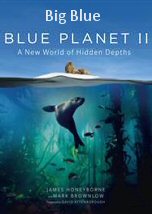
Big Blue

   2017    Nature
The big blue is the world's greatest wilderness, far from shore and many kilometres deep. It's a vast marine desert where there is little to eat and nowhere to hide. Yet it's home to some of the biggest and most spectacular creatures on earth. This episode reveals what it takes to survive in this savage and forbidding world. We witness feats of incredible endurance, moments of high drama and extraordinary acts of heart-wrenching self-sacrifice. Every animal in the big blue must find their own unique way to survive. Sperm whales have the largest brains in the world. They live for 80 years, and we are only now beginning to learn the extraordinary complexity of their language of clicks - thought to coordinate the whole family in everything from childcare to hunting. With special pressure-proof cameras, we witness record-breaking feats of endurance as they hunt for squid a kilometre down into the abyss. Only recently have we begun to solve the mystery of where baby turtles disappear to in their early years. They leave the crowded waters of the coast and head to the open ocean, where they use floating debris like logs as life rafts. Here they remain until adulthood, adrift on the high seas in relative safety away from coastal predators. Over half of all animals in the open ocean drift in currents. Jellyfish cross entire oceans feeding on whatever happens to tangle with their tentacles. The jelly-like Portuguese man-of-war can harness sail power to fish with its deadly tentacles. Sometimes there is a brief explosion of food in this marine desert, but ocean hunters must be fast to make the best of this bonanza. We witness super pods of up to 5,000 spinner dolphins racing to herd vast shoals of lanternfish, briefly caught at the surface where it is thought they spawn. New aerial footage reveals, for the first time, the truth to a centuries-old sailors' legend of the 'boiling seas' - the spectacular feeding frenzy of 90kg tuna and dolphins smashing through the lantern fish shoals turning the sea white with foam.
Series: Blue Planet II

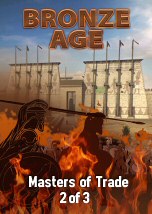
Masters of Trade

   2016    History
Trade, and in particular trade in luxury goods, drove the commerce economies of the Bronze Age. This is the time when the first super powers in history, Egypt and Mesopotamia, emerge and dominate the 'world' stage of the Mediterranean and Aegean seas and surrounding areas.
Series: Bronze Age

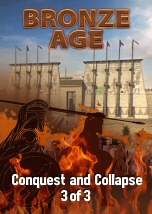
Conquest and Collapse

   2016    History
The Bronze Age had the first large urban centers, powerful kingdoms and armies, writing, and trade routes across vast areas. What led to the collapse of the city-state entities and the end of the Bronze Age? Possibly a perfect storm of uncontrollable factors that are still being researched.
Series: Bronze Age

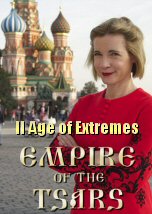
Age of Extremes

   2017    History
Lucy Worsley continues her journey through Russia in the footsteps of the Romanovs, the most powerful royal dynasty in modern European history. In this episode she examines the extraordinary reign of Catherine the Great, and the traumatic conflict with napoleonic France that provides the setting for the novel War and Peace. At the magnificent palace of Peterhof near St Petersburg, Lucy charts the meteoric rise of Catherine the Great, who seized the Russian throne from her husband Peter III in 1762 and became the most powerful woman in the world. Catherine was a woman of huge passions - for art, for her adopted country (she was German by birth) and for her many lovers.
Catherine expanded her empire through military victories overseas, while at home she encouraged education and introduced smallpox inoculation to Russia. But Catherine struggled to introduce deeper reforms, and the institution of serfdom remained largely unchanged. Lucy explains how this injustice fuelled a violent rebellion. Nevertheless, Catherine left Russia more powerful on the world stage than ever. But all she had achieved looked set to be undone when Napoleon invaded Russia in 1812. Lucy relives the pivotal battle of Borodino, when the Russian army finally confronted the French forces; the traumatic destruction of Moscow; and, under Catherine's grandson Alexander, the eventual victory over the French that provided the Romanov dynasty with its most glorious hour.
Series: Empire of the Tsars
Leaving Neverland

Leaving Neverland

2019  Culture
Sex Explained

Sex Explained

2020  Medicine
Spectacular Earth

Spectacular Earth

2022  Nature
Clarkson Farm

Clarkson Farm

2021  Nature
The Human Body

The Human Body

1998  Medicine
P.U.L.S.E

P.U.L.S.E

2006  Art