Seafood is a substantial part of the daily diet of over three billion people and oceans absorbs almost a third of all the greenhouse gases we emits. Buy the ocean it is not what it once was. Scenes of extraordinary ocean abundance now only exist in far-off places or in tales from the past. We urgently need to mend our relationship with our oceans and allow them to thrive once again. Prince William, David Attenborough and Shakira find out about inspiring people and projects across the world that can help us stop damaging the oceans and enable their revival.
Deep in the jungles of Taiwan lives female giant golden orb-weaver spider -- among the biggest web building spiders on the planet. With a leg-span of almost eight inches and silk like kevlar, she's a fearsome predator. But the orb spiders must find a way to mate with her male counterparts, who are approximately 10 times smaller and 500 times lighter than she is.
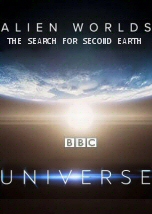
Humans have long gazed up at the night sky, wondering whether other lifeforms and intelligences could be thriving on worlds far beyond our own. But over the last few decades, ultra-sensitive telescopes and dogged detective work have transformed alien planet-hunting from science fiction into hard fact. We expected to find worlds similar to the planets in our own solar system, but we instead discovered a riot of exotic worlds. Vivid animation based on data from the most successful planet hunter of them all, the Kepler space telescope, brings these worlds into view: puffy planets with the density of polystyrene, unstable worlds orbiting two suns and 1,000-degree, broiling gas giants with skies whipped into titanic winds. But perhaps the most startling discovery was the number of worlds that may be contenders for a second Earth, at the right distance from their sun to have that ingredient so crucial for life as we know it, liquid water. Amongst them, we witness the most tantalizing discovery of all: a so-called ‘super-Earth’, situated in the Goldilocks zone - the area just the right distance from a sun to potentially support life - and with the faint signal of water in its atmosphere.
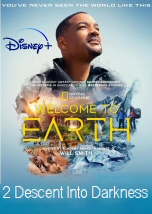
In the second episode, Will Smith descends 3,300 feet to the bottom of the ocean in a deep-water submersible, where even fewer people have gone than outer space. Along the way down, Will and explorer Diva Amon investigate how colour is used in the natural world and the role of bioluminescence. In the oceans, nearly 80 percent of animals use bioluminescence in some way, possibly the most common form of communication on the planet.
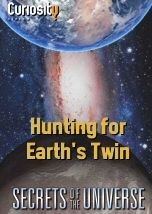
In just one generation, our ability to search for planets beyond our solar system has transformed. With modern techniques and telescopes, planetary scientists have found thousands of exoplanets in our universe, and many of them have the perfect conditions for life. Are we about to find Earth’s twin?
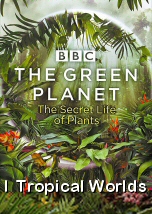
Dive with David Attenborough into a world where a single life can last a thousand years. See things no eye has ever seen, and discover the dramatic, beautiful plant life of Earth. In the first episode, Sir David Attenborough shows how more kinds of plants are crammed together in the tropical rainforests than anywhere else on Earth. The result is astonishing beauty and intense competition - a plant battleground. New filming techniques allow us to enter the plants’ world and see it from their perspective and on their timescale. From fast-growing trees to flowers that mimic dead animals, this is a journey into a magical world that operates on a different timescale to our own.

















Prince William, David Attenborough and Shakira find out about inspiring people and projects across the world that can help us stop damaging the oceans and enable their revival.