We sure lucked out with Planet Earth. Blue skies, rolling hills, water everywhere. But our home didn't come like this out of the box. Earth was a real fixer-upper, and it took some seriously hard work to build this paradise. Nearly four billion years of renovation. Some tiny, some huge, to make this house a home. Creatures on Earth don't just live and die. They actually change the world around them. The story of how for nearly 4 billion years, microbes, plants and animals have emerged and sculpted the planet's surface and atmosphere in the strangest of ways.
This is our home, the earth it's, it's the only place we've got. It is one strange rock because it's ours and we are here and we don't know if any other place in the universe, yet, that can support life. We're very lucky to have it as our home. Astronauts including the legendary Peggy Whitson, who spent 665 days in space, speak about how their concepts of home have changed since their experience.
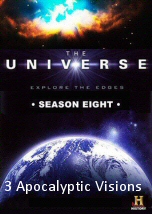
The end is coming. But which cosmic catastrophe will deliver the death blow? Were the Vikings right to fear the frozen apocalypse of an endless winter? Did the Buddhists correctly predict a fiery end to life on Earth? Or will the thunderous Christian vision of Armageddon come crashing down from the stars? Which ancient prophesy do scientists believe accurately foretells our doom? And how close are we to the end of the world? This film explores all the possibilities Apocalyptic Visions to the Future.
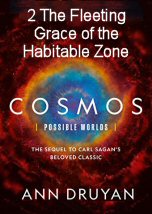
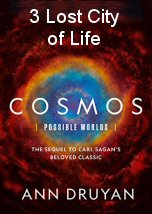
Episode 3 delves into how life began on a roiling, violent Earth and explores the story behind Victor Goldschmidt, the man who found the first clues to life's beginnings on our planet. Neil deGrasse Tyson takes viewers on a journey through space and time to witness the tenacity and creativity of life on Earth and the prospects of life throughout the universe.
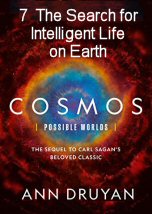
Episode 7 focuses specifically on first contact and the search for intelligent life in the vastness of the cosmos. Are humans ready to make first contact with other intelligent beings? Is our technology even sophisticated enough to detect communication signals from another world? Who are we to search for alien intelligence when we can't even recognize or respect the consciousness all around us, or even beneath our feet. Neil deGrasse Tyson reveals the hidden underground network that is a collaboration of four kingdoms of life, and a true first contact story between humans and beings who communicate in a symbolic language and have maintained a representative democracy for many tens of millions of years.
At 11 o'clock on New Year's Eve of the Cosmic Calendar, Homo erectus stood up for the first time, freeing its hands and earning the species its name. They began to move around, to explore, daring to risk everything to get to unknown places. Our Neanderthal relatives lived much as we did and did many of the things we consider to be 'human.' More restless than their cousins the Neanderthals and Denisovans, our Homo sapiens ancestors crossed seas and unforgiving landscapes, changing the land, ocean and atmosphere, leading to mass extinction. The scientific community gave our age a new name, 'Anthropocene.' Since the first civilizations we've wondered if there's something about human nature that contains the seeds of our destruction. Syukuro Manabe was born in rural Japan and took an intense interest in Earth's average global temperature. In the 1960's, he would assemble the evidence he needed to predict the increase of Earth's temperature due to greenhouse gases until it becomes an uninhabitable and toxic environment, leading to our extinction. 'This doesn't have to be,' says Neil deGrasse Tyson, 'it's not too late. There's another hallway, another future we can still have; we'll find a way.'







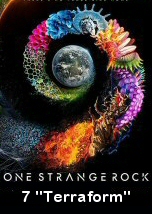
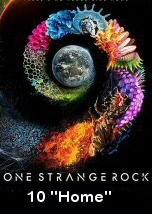



The story of how for nearly 4 billion years, microbes, plants and animals have emerged and sculpted the planet's surface and atmosphere in the strangest of ways.