
Last Watched

"Disco"  Sort by

Orthodoxy From Empire to Empire

   2011    Culture
In the third part of his journey into the history of Christianity, Professor Diarmaid MacCulloch charts Orthodoxy's extraordinary fight for survival. After its glory days in the eastern Roman Empire, it stood right in the path of Muslim expansion, suffered betrayal by crusading Catholics, was seized by the Russian tsars and faced near-extinction under Soviet communism. MacCulloch visits the greatest collection of early icons in the Sinai desert, a surviving relic of the iconoclastic crisis in Istanbul and Ivan the Terrible's cathedral in Moscow to discover the secret of Orthodoxy's endurance.
Series: A History of Christianity
God in the Dock

   2011    Culture
Diarmaid MacCulloch's own life story makes him a symbol of a distinctive feature about Western Christianity - scepticism, a tendency to doubt which has transformed both Western culture and Christianity. In the final programme in the series, he asks where that change came from. He challenges the simplistic notion that faith in Christianity has steadily ebbed away before the relentless advance of science, reason and progress, and shows instead how the tide of faith perversely flows back in. Despite the attacks of Newton, Voltaire, the French Revolutionaries and Darwin, Christianity has shown a remarkable resilience. The greatest damage to Christianity was actually inflicted to its moral credibility by the two great wars of the 20th century and by its entanglement with Fascism and Nazism. And yet it is during crisis that the Church has rediscovered deep and enduring truths about itself, which may even be a clue to its future.
Series: A History of Christianity
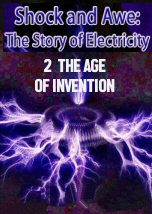
The Age of Invention

   2014    Science
Just under 200 years ago scientists discovered something profound, that electricity is connected to another of nature's most fundamental forces - magnetism. In the second episode, Jim discovers how harnessing the link between magnetism and electricity would completely transform the world, allowing us to generate a seemingly limitless amount of electric power which we could utilise to drive machines, communicate across continents and light our homes. This is the story of how scientists and engineers unlocked the nature of electricity in an extraordinary century of innovation and invention.
Series: Shock and Awe: The Story of Electricity

Revelations and Revolutions

   2014    Science
Electricity is not just something that creates heat and light, it connects the world through networks and broadcasting. After centuries of man's experiments with electricity, the final episode tells the story of how a new age of real understanding dawned - how we discovered electric fields and electromagnetic waves. Today we can hardly imagine life without electricity - it defines our era. As our understanding of it has increased so has our reliance upon it, and today we are on the brink of a new breakthrough, because if we can understand the secret of electrical superconductivity, we could once again transform the world.
Series: Shock and Awe: The Story of Electricity

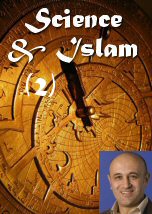
The Empire of Reason

   2017    History
Al-Khalili travels to northern Syria to discover how, a thousand years ago, the great astronomer and mathematician Al-Biruni estimated the size of the earth to within a few hundred miles of the correct figure. He discovers how medieval Islamic scholars helped turn the magical and occult practice of alchemy into modern chemistry. In Cairo, he tells the story of the extraordinary physicist Ibn al-Haytham, who helped establish the modern science of optics and proved one of the most fundamental principles in physics - that light travels in straight lines. Prof Al-Khalili argues that these scholars are among the first people to insist that all scientific theories are backed up by careful experimental observation, bringing a rigour to science that didn't really exist before.
Series: Science and Islam

The Day Pictures Were Born

   2006    Art
Dr Nigel Spivey explores how art influences life by tracing the development of the image from cave paintings to our modern obsession with images. Dr. Spivey begins his investigation by travelling to the Cave of Altamira near the town of Santillana del Mar in Cantabria, Spain, where in 1879 a young girls exclamation of 'Papa, look, oxen!' to her father, local amateur archaeologist Marcelino Sanz de Sautuola, is explained to have meant that Maria had just become the first modern human to set eyes on the first gallery of prehistoric paintings ever to be discovered.
Series: How Art Made the World
Rome Second Season

Rome Second Season

  History
The Story of Science

The Story of Science

2010  History
Atom

Atom

2007  Science
The Crime of the Century

The Crime of the Century

2021  Medicine
Life In Cold Blood

Life In Cold Blood

2008  Nature
Asia

Asia

2024  Nature