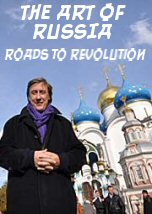
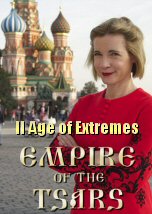
Lucy Worsley continues her journey through Russia in the footsteps of the Romanovs, the most powerful royal dynasty in modern European history. In this episode she examines the extraordinary reign of Catherine the Great, and the traumatic conflict with napoleonic France that provides the setting for the novel War and Peace. At the magnificent palace of Peterhof near St Petersburg, Lucy charts the meteoric rise of Catherine the Great, who seized the Russian throne from her husband Peter III in 1762 and became the most powerful woman in the world. Catherine was a woman of huge passions - for art, for her adopted country (she was German by birth) and for her many lovers. Catherine expanded her empire through military victories overseas, while at home she encouraged education and introduced smallpox inoculation to Russia. But Catherine struggled to introduce deeper reforms, and the institution of serfdom remained largely unchanged. Lucy explains how this injustice fuelled a violent rebellion. Nevertheless, Catherine left Russia more powerful on the world stage than ever. But all she had achieved looked set to be undone when Napoleon invaded Russia in 1812. Lucy relives the pivotal battle of Borodino, when the Russian army finally confronted the French forces; the traumatic destruction of Moscow; and, under Catherine's grandson Alexander, the eventual victory over the French that provided the Romanov dynasty with its most glorious hour.
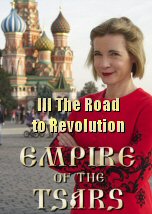
The years 1825-1918 were bloody and traumatic, a period when four tsars tried - and failed - to deal with the growing pressure for constitutional reform and revolution. In 1861, millions of enslaved serfs were freed by the Tsar-Liberator, Alexander II. But Alexander paid the ultimate penalty for opening the Pandora's box of reform when he was later blown up by terrorists on the streets of St Petersburg. Elsewhere, there was repression, denial, war and - in the case of the last tsar, Nicholas II - a fatalistic belief in the power of God, with Nicholas's faith in the notorious holy man Rasputin being a major part in his undoing. Lucy Worsley also details the chilling murder of Nicholas and his family in 1918, and asks whether all of this horror have been avoided.
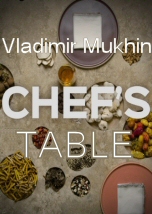
A powerful depiction of Vladimir Mukhin's struggle to resuscitate an almost forgotten russian cuisine, going against the established tradition. Be prepared for stunning images of culinary creations at White Rabbit, some will leave you uneased. A fifth-generation chef, Mukhin worked in his father’s kitchen as a young man, preparing Soviet-era classics. So, like generations of youths before him, Mukhin had to rebel against the old man. He left his small hometown of Essentuki for Moscow and became obsessed with modern techniques and food from across Europe. It wasn’t until he worked as a sous chef in France, when he collaborated on a menu with chef Christian Etienne, that Mukhin realized Russian cuisine could exist within modern cooking. 'His French clients who ate it were amazed,' he says. ¡They loved his Russian cooking.'
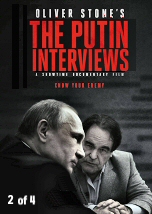
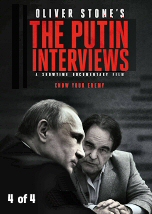
Witness the most detailed portrait of Putin ever granted to a Western interviewer. This series provides intimate insight into Putin's personal and professional lives, from his childhood under communism, to his rise to power, his relations with four U.S. presidents, and his surprising takes on U.S.-Russian relations today. Oscar-winning filmmaker Oliver Stone was granted unprecedented access to Russian president Vladimir Putin during more than a dozen interviews over two years, with no topic off-limits.
This is a destabilizing documentary that challenges Americans’ narratives and asks the viewer to engage in a conversation with a slippery subject. It’s riveting in how dangerous and intimate it feels, leveraging its multiple camera-angles and hand-held shots to make the viewer feel as if they, too, are in the room with Vladimir Putin. As a conversation that covers a vast span of Russian history, culture, and politics as refracted through the mind of Russia’s president — it’s often remarkable. During an extraordinary career, Stone has never pretended to be an unbiased journalist and he’s not about to feign pretense now.
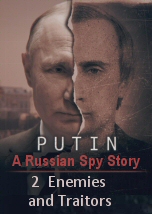
This second instalment looks at how Vladimir Putin arrived in the Kremlin as a vulnerable and unknown president, whom the Russian oligarchs expect to control. The programme reveals how he asserted his hold on power and ultimately surrounded himself with his KGB peers, as well as his philosophy as regards traitors and enemies. The film also examines the stories of businessman Boris Berezovsky and defector Alexander Litvinenko, who both stood up to Putin and wound up dead on British soil.





Catherine expanded her empire through military victories overseas, while at home she encouraged education and introduced smallpox inoculation to Russia. But Catherine struggled to introduce deeper reforms, and the institution of serfdom remained largely unchanged. Lucy explains how this injustice fuelled a violent rebellion. Nevertheless, Catherine left Russia more powerful on the world stage than ever. But all she had achieved looked set to be undone when Napoleon invaded Russia in 1812. Lucy relives the pivotal battle of Borodino, when the Russian army finally confronted the French forces; the traumatic destruction of Moscow; and, under Catherine's grandson Alexander, the eventual victory over the French that provided the Romanov dynasty with its most glorious hour.