





Last Watched

"War"  Sort by

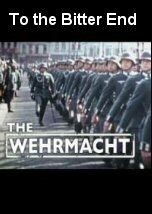
To the Bitter End

   2007    History
The determination of the German forces to keep on fighting in the face of defeat had disastrous consequences. After the Allied landings in the summer of 1944, the Wehrmacht was on the defensive on all fronts. It was clear to the German generals interned at Trent Park that Germany would soon lose the war. In mid-1944, Gerhard Graf von Schwerin chose to use common sense instead of blindly obeying Hitler's orders. He decided to surrender the city of Aachen to the US army to avoid bloodshed. Other commanders such as Field Marshal Ferdinand Schorner kept on pushing their soldiers to give their all. Despite being outnumbered by the Soviet forces, Schorner forced his soldiers to hold out in Sworbe, a 200 square kilometre peninsula on the coast of Estonia. Thousands of soldiers died. Yet Schorner's attitude and the urging by Hitler and Goebbels to hold out were accepted by a large number of young soldiers. By April 1944, the Ruhr pocket was completely surrounded, yet Field Marshal Model refused to surrender, so that 1.2 million German soldiers and a large number of Allied soldiers died between January and May 1945.
Series: The Wehrmacht
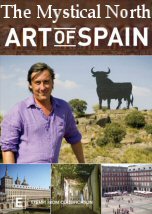
The Mystical North

   2008    Art
Graham-Dixon reveals how the north of the country has produced some of the most dazzling and iconic art of the modern age. Spain's turbulent history has shaped artists from Francisco Goya to Pablo Picasso. Graham-Dixon argues that Spanish architecture is the art form now taking the nation forward in the new millennium.
Series: Art of Spain

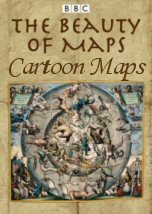
Cartoon Maps

   2010    Culture
The series concludes by delving into the world of satirical maps. How did maps take on a new form, not as geographical tools, but as devices for humour, satire or storytelling? Graphic Artist Fred Rose perfectly captured the public mood in 1880 with his General Election maps featuring Gladstone and Disraeli, using the maps to comment upon crucial election issues still familiar to us today. Technology was on the satirist's side with the advent of high-speed printing allowing for larger runs at lower cost. In 1877, when Rose produced his 'Serio Comic Map of Europe at War', maps began to take on a new direction and form, reflecting a changing world. Rose's map exploited these possibilities to the full using a combination of creatures and human figures to represent each European nation. The personification of Russia as a grotesque-looking octopus, extending its tentacles around the surrounding nations, perfectly symbolised the threat the country posed to its neighbours.
Series: The Beauty of Maps

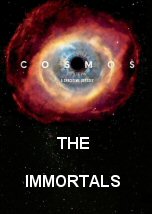
The Immortals

   2014    Science
This episode covers the nature of how life may have developed on Earth and the possibility of life on other planets. Tyson begins by explaining how the human development of writing systems enabled the transfer of information through generations, describing how Princess Enheduanna ca. 2280 BCE would be one of the first to sign her name to her works, and how Gilgamesh collected stories, including that of Utnapishtim documenting a great flood comparable to the story of Noah's Ark. Tyson explains how DNA similarly records information to propagate life, and postulates theories of how DNA originated on Earth, including evolution from a shallow tide pool, or from the ejecta of meteor collisions from other planets. In the latter case, Tyson explains how comparing the composition of the Nakhla meteorite in 1911 to results collected by the Viking program demonstrated that material from Mars could transit to Earth, and the ability of some microbes to survive the harsh conditions of space. With the motions of solar systems through the galaxy over billions of years, life could conceivably propagate from planet to planet in the same manner. Tyson then moves on to consider if life on other planets could exist. He explains how Project Diana performed in the 1960s showed that radio waves are able to travel in space, and that all of humanity's broadcast signals continue to radiate into space from our planet. Tyson notes that projects have since looked for similar signals potentially emanating from other solar systems. Tyson then explains that the development and lifespan of extraterrestrial civilizations must be considered for such detection to be realized. He notes that civilizations can be wiped out by cosmic events like supernovae, natural disasters such as the Toba disaster, or even self-destruct through war or other means, making probability estimates difficult. Tyson describes how elliptical galaxies, in which some of the oldest red dwarf stars exist, would offer the best chance of finding established civilizations. Tyson concludes that human intelligence properly applied should allow our species to avoid such disasters and enable us to migrate beyond the Earth before the Sun's eventual transformation into a red giant.
Series: Cosmos: A Spacetime Odyssey

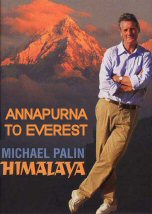
Annapurna to Everest

   2004    Culture
During a Gurkha recruitment Palin is disturbed by Maoist insurgents, but survives to suffer as he climbs to 15,000 feet and sees the majesty of Annapurna Sanctuary. In Kathmandu he is blessed by the Nepalese king before meeting some holy men. Crossing into Tibet, he meets his first yaks at the highest monastery in the world, before heading up the Rongbuk glacier towards the summit of Everest.
Series: Himalaya with Michael Palin

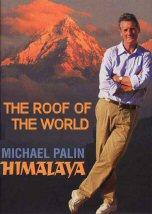
The Roof of the World

   2004    Culture
Leaving Everest base camp to take the high road to Lhasa to see what the Chinese have done to Tibet. He sees that religion is once again tolerated, while the old Tibetan centre of the city is being replaced with modern Chinese shopping malls and nightclubs. Following the pilgrims to the holy Namtso Lake, he gets warm in a hot spring before learning how to milk a yak with a nomad family.
Series: Himalaya with Michael Palin
Leaving Neverland

Leaving Neverland

2019  Culture
Vikings Season 2

Vikings Season 2

2014  History
Empire of the Tsars

Empire of the Tsars

2017  History
Latino Americans

Latino Americans

2013  History
Natural World

Natural World

2015  Nature
Love On The Spectrum

Love On The Spectrum

2019  Culture