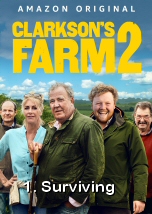
Another year in the life of Diddly Squat Farm, run by Jeremy Clarkson, Britain's best-known but least-qualified amateur farmer. Season 2 of Clarkson’s Farm promises to be even better than the first as Clarkson and his rag tag group combat the public, the council, and the government. In the first episode, Clarkson attempts to diversify his farm's revenue sources (having made only £144 in the previous year) in an effort to increase his profits. He decides that his primary way of doing this will be a new herd of cows and promptly purchases several of the animals. However, the timing of when they will bring in money and the necessity of building an enclosure for them causes problems for Jeremy and Charlie. Meanwhile, inspired by the success of the farm shop, Clarkson has the idea to open a restaurant in the abandoned lambing barn to sell his beef and lamb, but he must deal with the cost of converting the barn and getting approval from the local council.
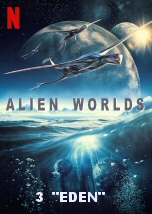
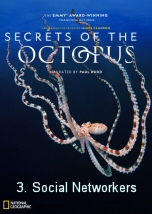
The third episode unveils the enigmatic world of octopuses, long believed solitary creatures, revealing their unexpected social behaviors. Follow Dr. Alex Schnell as she forms a unique bond with Scarlett, a shy female day octopus, challenging the long-held belief that these creatures are ultimate loners. Witness intense interactions, from rival confrontations to cooperative hunting with other species, shedding light on the complex social dynamics of these intelligent beings. The film also takes you deep beneath the ocean to octopus nurseries and an extraordinary octopus oasis where multiple species coexist. Discover how octopuses use their remarkable problem-solving abilities and sophisticated communication to navigate their environments and form selective social interactions. ‘Social Networkers’ redefines our understanding of these ancient, intelligent marine animals and their secret social lives, making it a must-watch for nature enthusiasts and curious minds alike.
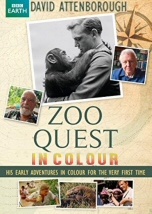
Thanks to a recent remarkable discovery in the BBC's Film Vaults, the best of David Attenborough's early Zoo Quest adventures can now be seen as never before - in colour - and with it the remarkable story of how this pioneering television series was made. First broadcast in December 1954, Zoo Quest was one of the most popular television series of its time and launched the career of the young David Attenborough as a wildlife presenter. Zoo Quest completely changed how viewers saw the world - revealing wildlife and tribal communities that had never been filmed or even seen before. Broadcast ten years before colour television was seen in the UK, Zoo Quest was thought to have been filmed in black and white. Until now. Using this extraordinary new-found colour film, together with new behind the scenes stories from David Attenborough and cameraman Charles Lagus, this 90 minute special showcases the very best of Zoo Quest to West Africa, Zoo Quest to Guiana and Zoo Quest for a Dragon in stunning HD colour for the very first time.
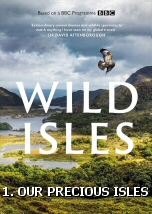
In the first episode, Sir David Attenborough reveals the unexpected wildlife riches of the British Isles, showcasing the dramatic and spectacular habitats that rival any across the globe. This journey uncovers the diversity of life in the UK's unique landscapes, from the intricate world of bumblebees to the swift lives of kingfishers. The episode captures extraordinary scenes of nature, including killer whales preying on seals, golden eagles in the Scottish mountains, the cunning tactics of woodland plants, and the perilous life of puffins evading gulls. It highlights Britain's geological diversity as a cornerstone of its natural wealth, contributing to an array of habitats and supporting a wide range of life. Britain's importance extends to being a haven for migratory birds, with our seas feeding 65% of the world's gannets and supporting the largest colony of northern gannets on Scotland's Bass Rock. The west coast of Scotland offers sanctuary to barnacle geese due to its abundant food and mild climate, though they remain vigilant against hunting sea eagles. Despite these natural treasures, Britain faces challenges as one of the most nature-depleted countries globally. Sir David Attenborough emphasizes the need to conserve and restore these wild isles for the enjoyment and benefit of future generations.
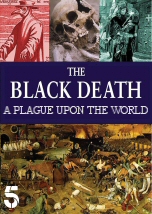
In an enthralling documentary, Dan Snow and archaeologist Raksha Dave delve into the catastrophic impact of the Black Death on Britain 700 years ago, a pandemic that extinguished around half of the population, or three million people. The duo embarks on a journey to trace the origins and merciless spread of the plague, starting from its arrival on Britain's South coast in June 1348, through the bustling trade routes that brought the disease to Melcombe Regis, Dorset. Their investigation takes them to various hotspots of the outbreak, including the Old Operating Theatre in London and Wildwood Animal Sanctuary in Kent, where they explore the role of rats in dispersing the bubonic plague. Through dramatic reconstructions and visits to places like Nottingham University's biomedical laboratories, they uncover the rapid spread and deadly impact of the plague, offering a month-by-month account of how it ravaged the country, decimating cities, towns, and villages alike. The documentary not only showcases the horrific symptoms and desperate attempts at cures through brutal medical practices of the time but also leverages cutting-edge research to explain why the Black Death remains the deadliest pandemic in history. The personal stories of victims, from princes to paupers, are brought to light, revealing the indiscriminate nature of the disease. Dan's visit to Canterbury Cathedral and Raksha's investigation into the recent discovery of mass graves beneath a tranquil London square underline the widespread desperation and devastation. Their journey through the history of the Black Death, culminating in the discovery of its indiscriminate toll and the unveiling of mass graves in London, not only sheds light on the darkest chapters of British history but also ignites a profound understanding of the tragedy, making a compelling case for why this documentary is a must-watch for anyone interested in the profound impacts of pandemics on human society.
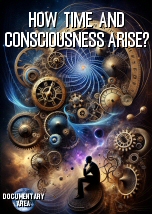
The documentary, an own production, immerses the viewer in a journey that blends science and philosophy, questioning the nature of time and unveiling a 4-dimensional universe, where space and time are integrated. We are invited to consider a universe in which past, present, and future coexist, suggesting that our linear perception of time might be more of a mental construction than a physical reality. The narrative progresses by exploring how quantum particles exist in states of probability until they are observed, at which point they acquire defined properties. Then, the provocative hypothesis is presented that observation also fixes the temporal dimension of the particles. The sensation of the flow of time and the distinction between past, present, and future are introduced as mental constructions, arising from the human brain's limited capacity to process the complexity of reality. It is then proposed that the mind, by observing itself, fixes itself in the temporal dimension, thus creating the illusion of the present. Finally, the impact of these theories on free will is discussed. This documentary challenges viewers to look beyond their everyday perceptions and consider the possibility that reality is much more complex and fascinating than our immediate experiences suggest. It is an invitation to explore the limits of science, philosophy, and the mind itself in search of answers to some of the deepest questions of existence.
More information on https://www.javier-serrano.blog/Ciencia/representacion_tridimensional_del_universo.php





In the first episode, Clarkson attempts to diversify his farm's revenue sources (having made only £144 in the previous year) in an effort to increase his profits. He decides that his primary way of doing this will be a new herd of cows and promptly purchases several of the animals. However, the timing of when they will bring in money and the necessity of building an enclosure for them causes problems for Jeremy and Charlie. Meanwhile, inspired by the success of the farm shop, Clarkson has the idea to open a restaurant in the abandoned lambing barn to sell his beef and lamb, but he must deal with the cost of converting the barn and getting approval from the local council.