Everywhere you go, you generate a cloud of data. You're trailing data, everything that you do is producing data. And then there are computers looking at that data that are learning, and these computers are essentially trying to serve you better. They're trying to personalize things to you. They're trying to adapt the world to you. So on the one hand, this is great, because the world will get adapted to you without you even having to explicitly adapt it. There's also a danger, because the entities in the companies that are in control of those algorithms don't necessarily have the same goals as you, and this is where I think people need to be aware that, what's going on, so they can have more control over it. We came into this new world thinking that we were users of social media and search engines. It didn't occur to us that social media and search engines were actually using us.
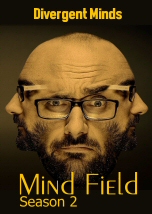
Autistic minds provide windows into how we all think, feel, and behave. A complete brain science should be able to account for all kinds of minds and brains. As long as some minds remain a mystery, so too will all minds. Michael Stevens travels to London to meet a blind, autistic savant with astonishing musical abilities, and volunteers to have his brain's function temporarily disrupted at UCLA's Neuromodulation Lab.
Episode 7 focuses specifically on first contact and the search for intelligent life in the vastness of the cosmos. Are humans ready to make first contact with other intelligent beings? Is our technology even sophisticated enough to detect communication signals from another world? Who are we to search for alien intelligence when we can't even recognize or respect the consciousness all around us, or even beneath our feet. Neil deGrasse Tyson reveals the hidden underground network that is a collaboration of four kingdoms of life, and a true first contact story between humans and beings who communicate in a symbolic language and have maintained a representative democracy for many tens of millions of years.
The 8th episode reviews Giovanni Cassini's life. His observations of Saturn and its moons would have an enduring effect on the scientific world. Neil deGrasse Tyson also narrates the mysterious untold story of the scientist who figured out how to go the Moon while fighting for his life in a WWI trench. Aleksandr Shargei changed his name to Yuri Kondratyuk out of fear for his life and wrote a manuscript on rocket motion and space colonization. This letter would end up capturing the attention of an engineer working on the Apollo program, John Houbolt, and would made the Apollo Mission possible. We will also know the saga of the twenty-year long odyssey of Cassini-Huygens spacecraft, a robotic explorer ordered to commit suicide on another world.
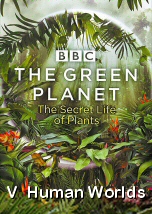
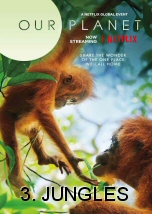
A rain forest is the richest habitat on Earth. Exactly how many species rain forests contain is unknown, but it runs into millions. And new ones are discovered every week. There are some, like the clouded leopard, we still know virtually nothing about. Although they cover just seven percent of the world's land area, jungles play a vital role in the health of the planet . Jungles and rainforests are home to an incredible variety of species like preening birds, intelligent orangutans and remarkably ambitious ants.
The search for climate change solutions requires passion, resources and a sense of urgency -- three qualities Bill Gates clearly possesses. Bill has founded a start-up called TerraPower. After extensive computer modelling, the idea showed promise. Its new reactor greatly reduced the chance of human error. Fuelled by depleted uranium, the travelling wave reactor functions like a slow-burning candle and requires refuelling only once every decade. Bill and his team believed they had finally developed the ideal energy source, a reactor that was clean, efficient, and most importantly, safe.





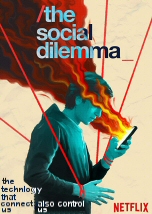
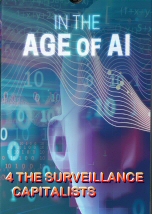

We came into this new world thinking that we were users of social media and search engines. It didn't occur to us that social media and search engines were actually using us.