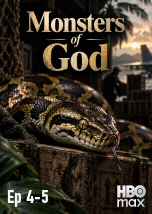
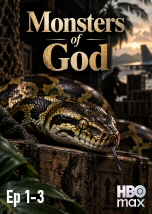
In the final two episodes of the series, the reptile trade enters a new and even more lucrative era. After prison, Tommy Crutchfield returns to find an industry transformed by the rise of genetically altered “morphs”, rare colour and pattern variations that can sell for enormous sums. What appears to be a more legitimate breeding business quickly collides again with illegal trafficking, as Operation Chameleon begins to expose the international network linking collectors, dealers and even major zoological institutions. The investigation then closes in on Anson Wong, the Malaysian trafficker described as one of the most powerful figures in the global reptile trade. As U.S. Fish and Wildlife agents work undercover to penetrate his organization, the story expands from rare snakes and lizards to critically endangered species such as the ploughshare tortoise, whose extraordinary black-market value has helped drive it toward extinction in the wild. These final episodes reveal how obsession, vast profits, corruption and international demand can turn the pursuit of exotic animals into a criminal empire with devastating consequences for wildlife.
Cobra Gypsies offers a contemporary and colorful window to the amazing ancient culture of the nomadic Kalbeliya tribe, living in rural Rajasthan, Northern India. Their name means 'those who love snakes'. The film explores their culture of eternal dance, syncopated music, snake charming, colorful fashion and the nomadic way of life of these exotic looking castoffs, ancestors to the modern Roma Gypsies living in Europe today.
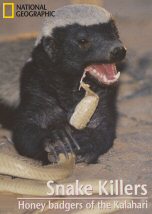
The honey badger looks like something you might buy in pet shop and give to children, but turns out to be one of the most violent and determined creatures ever to scuttle across the face of the earth. Nothing in the badger’s world-not even the badgers themselves-are safe from its remarkable ability to create havoc and cause harm. Like a meter long skunk with the brain of a shark the Honey Badger’s metabolism compels it to eat constantly and live on the run. Its diet is admirably inclusive ranging from insects to its own young. If an animal is too big to eat then the badger will fight it anyway, indeed it is this almost supernatural tenacity that compels you respect it, as well as yielding some of the most spectacular sequences in the film. Five foot long cobra sleeping in the top of tree? No problem, the badger scoots up and bites its head off. When an ailing badger is attacked by a full size leopard it takes the leopard over an hour to finish it off. When one is bitten in the face by a snake that can kill a man, it just lies down for a while and sleeps it off.
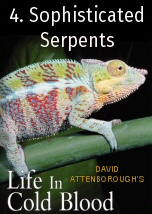
David Attenborough reveals the fascinating lives of snakes, the most misunderstood group of reptiles. A CCTV stakeout of wild rattlesnakes hunting shows, for the first time, what sophisticated predators they truly are. Attenborough is also on the receiving end of a spitting cobra's chemical weapons system, while the surprisingly beautiful and tender side of snakes is displayed in the sinuous courtship of kingsnakes, and the water birth of 15 beautiful yellow anaconda babies.
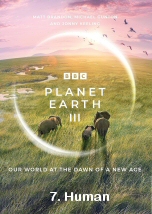
This featured episode of the documentary series takes viewers on a captivating journey around the world, showcasing the astonishing ways in which animals adapt to living alongside humans. In Sauraha, Nepal, a rhino navigates through human-inhabited areas in search of food. In Bali, long-tailed macaques have learned to trade stolen items for food, demonstrating their intelligence and adaptability. The bustling streets of New York City are home to pavement ants that thrive on human leftovers, while in India, revered cobras coexist with humans in a unique cultural relationship. Melbourne, Australia, features nocturnal frogmouths benefiting from urban lighting for hunting, and Lake Tahoe in North America sees black bears adapting to easy food sources in human settlements. The documentary also delves into the challenges faced by wildlife due to human expansion and climate change. It highlights the plight of African elephants in Kenya conflicting with farmers, the impact of overfishing on humpback whales in Vancouver Island, and the dramatic increase of desert locusts in northeastern Africa due to climate-induced conditions. The episode concludes by emphasizing the importance of reimagining our relationship with nature. It suggests a shift towards plant-based diets to reduce agricultural land use and the potential of vertical farming technologies, offering hope and solutions for a sustainable coexistence with wildlife.
What begins as a fascination with rare and dangerous reptiles grows into a lucrative global underground built on smuggling, obsession and rivalry. From the eccentric dealers who helped create the exotic animal trade to the investigators determined to stop it, the series exposes a hidden world where protected species, major zoos, criminal networks and enormous sums of money collide. At its center are men such as Tommy Crutchfield and Hank Molt, whose bitter feud reveals how quickly passion for reptiles can turn into betrayal, trafficking and environmental damage. The documentary also shows how this trade helped reshape ecosystems and drove entire species closer to extinction. In the first three episodes, the story traces the rise of the reptile-smuggling world from the 1970s onward. The obsession with owning animals no one else could obtain fuels a booming illegal market, while authorities begin taking notice of dealers operating across borders. In Florida, Ray Van Nostrand enters the business and becomes entangled with Miami’s darker underworld of drug trafficking and gun-running, drawing the attention of the DEA. Later, his son Mike attempts to transform the family operation into a legitimate international import-export empire, only for old criminal connections and his father’s return to threaten everything he has built.














The investigation then closes in on Anson Wong, the Malaysian trafficker described as one of the most powerful figures in the global reptile trade. As U.S. Fish and Wildlife agents work undercover to penetrate his organization, the story expands from rare snakes and lizards to critically endangered species such as the ploughshare tortoise, whose extraordinary black-market value has helped drive it toward extinction in the wild. These final episodes reveal how obsession, vast profits, corruption and international demand can turn the pursuit of exotic animals into a criminal empire with devastating consequences for wildlife.