As artificial intelligence accelerates at a breathtaking pace, filmmaker Daniel Roher sets out to understand whether humanity is approaching an extraordinary new era or a catastrophe of its own making. What begins as a personal investigation becomes far more urgent when he and his wife learn they are expecting a child. Faced with predictions ranging from revolutionary medical breakthroughs and powerful new tools for creativity to mass unemployment, deepfakes, autonomous systems and even existential risk, he asks some of the world’s leading AI thinkers a deceptively simple question: should we be excited about the future, or terrified of it? The film explores how generative AI works, why its capabilities are advancing so quickly and what could happen if increasingly powerful systems become difficult to control. Experts debate AI safety and alignment, the race between competing companies, the possibility of machines seeking greater power, and the social consequences of automation and concentrated wealth. At the same time, the documentary confronts the technology’s remarkable promise, from personalized education to scientific discovery and potential cancer treatments. Moving between anxiety and hope, Roher ultimately searches for a way to face an uncertain future not as a pessimist or a blind optimist, but as something in between: an “Apocaloptimist.”
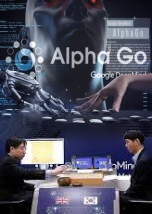
With more board configurations than there are atoms in the observable universe, the ancient Chinese game of 'Go' has long been considered a grand challenge for artificial intelligence. On March 9, 2016, the worlds of Go and AI collided in South Korea for an extraordinary best-of-five-game competition, coined the Google DeepMind Challenge Match. Hundreds of millions of people around the world watched as a legendary Go master took on an unproven AI challenger for the first time in history. AlphaGo chronicles a journey from the halls of Cambridge, through the backstreets of Bordeaux, past the coding terminals of DeepMind in London, and, ultimately, to the seven-day tournament in Seoul. As the drama unfolds, more questions emerge: What can artificial intelligence reveal about a 3000-year-old game? What can it teach us about human mind?
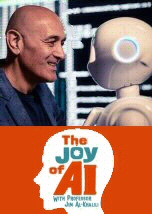
Professor Jim Al-Khalili looks at how we have created machines that can simulate, augment, and even outperform the human mind - and why we shouldn't let this spook us. He reveals the story of the pursuit of AI, the emergence of machine learning and the recent breakthroughs brought about by artificial neural networks. He shows how AI is not only changing our world but also challenging our very ideas of intelligence and consciousness.
Along the way, we'll investigate spam filters, meet a cutting-edge chatbot, look at why a few altered pixels makes a computer think it's looking at a trombone rather than a dog and talk to Demis Hassabis, who heads DeepMind and whose stated mission is to 'solve intelligence, and then use that to solve everything else'. Stephen Hawking remarked 'AI could be the biggest event in the history of our civilisation. Or the worst'. Jim argues that AI is a potent new tool that should enhance our lives, not replace us.

















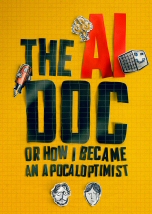


The film explores how generative AI works, why its capabilities are advancing so quickly and what could happen if increasingly powerful systems become difficult to control. Experts debate AI safety and alignment, the race between competing companies, the possibility of machines seeking greater power, and the social consequences of automation and concentrated wealth. At the same time, the documentary confronts the technology’s remarkable promise, from personalized education to scientific discovery and potential cancer treatments. Moving between anxiety and hope, Roher ultimately searches for a way to face an uncertain future not as a pessimist or a blind optimist, but as something in between: an “Apocaloptimist.”